
Can Nicaragua be far behind? And after Nicaragua, will it be Cuba? After Cuba will it be the Dominican Republic? And after the Dominican Republic, who knows?
Ed Broadbent, Emergency Debate on
the US Invasion of Grenada
October 27, 1983
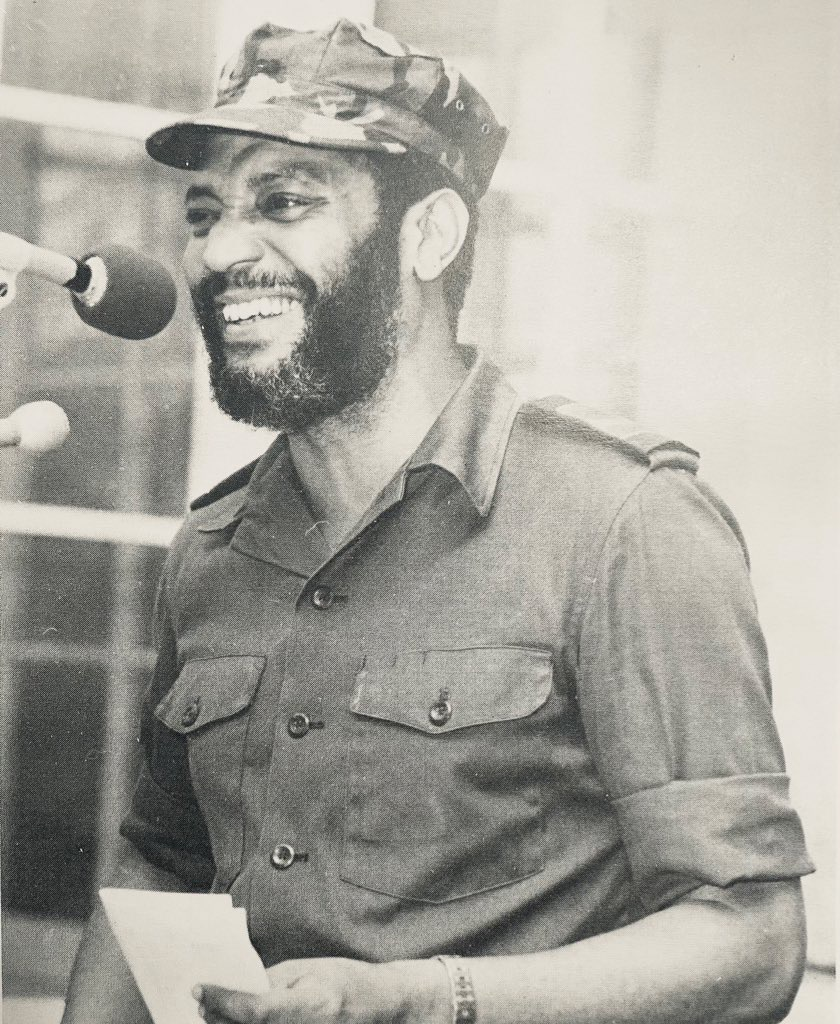
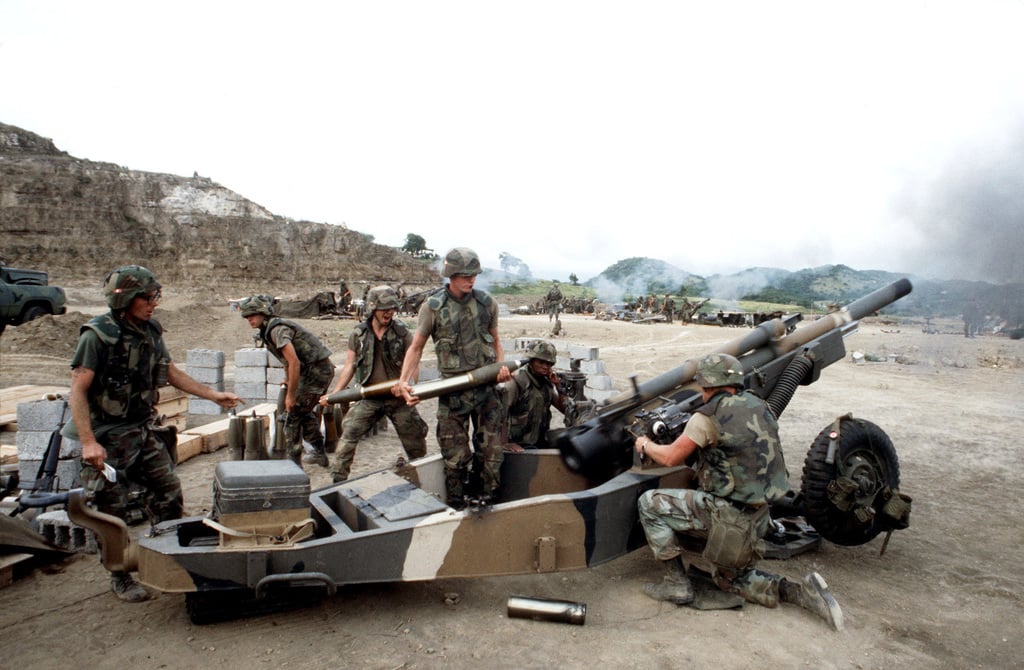
On the morning of October 25, 1983, in just one of the Reagan administration’s many acts of aggression in the region, the United States invaded Grenada. The invasion, which was officially justified on the absurd grounds that the tiny island nation represented a security threat to the USA, came amidst the overthrow and murder of Prime Minister Maurice Bishop and was widely condemned across the world.
The next month, by an overwhelming vote of 108 to 9, the United Nations General Assembly adopted a resolution “[deeply deploring] the armed intervention in Grenada” which, it added, constituted “a flagrant violation of international law and of the independence, sovereignty and territorial integrity of that State.”
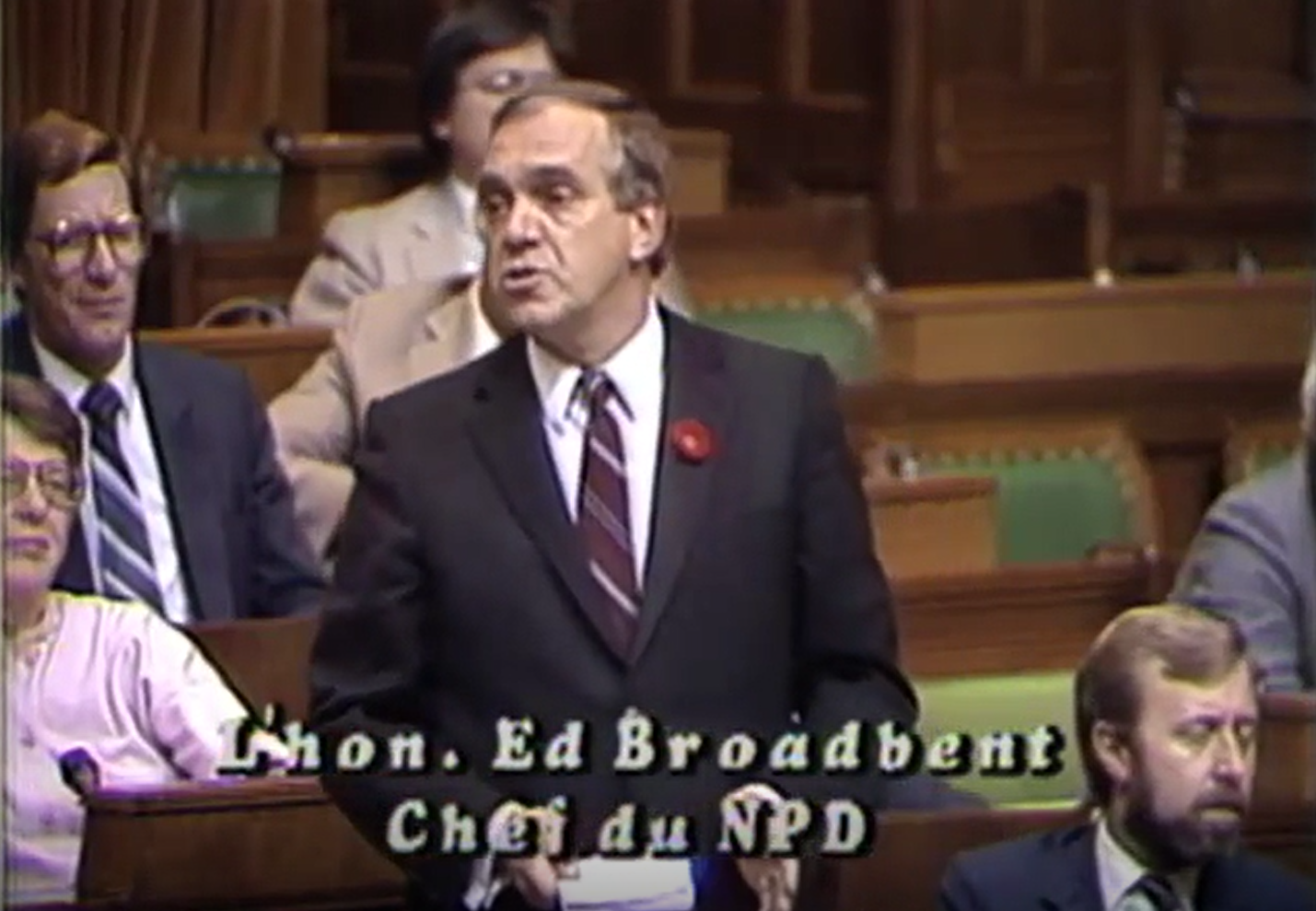
In a powerful address to the Canadian House of Commons on October 27, 1983, New Democratic Party leader Ed Broadbent fiercely condemned America’s invasion of Grenada and warned that the Reagan administration was “turning […] the whole of Central America into a crusade against any kind of political regime which can be seen in any sense […] to be philosophically left-of-centre,” adding:
It is supporting in this holy crusade-or unholy crusade-any kind of regime on the right, providing that such regime supports the government of the United States. Just as during the Crusades, Mr. Speaker, when the so-called Christian heads of state perverted the very principles of morality, of Christianity, in the name of Christianity, so do we now find people in the Reagan administration completely perverting the most fundamental principles of democracy in the name of democracy.
Throughout the 1980s, in his capacity as both NDP leader and Vice President of the Socialist International, Ed Broadbent remained an important critic of American foreign policy in the Caribbean, South America, and beyond, and a fierce voice for democracy and peace.
Amid the Trump administration’s renewed aggression throughout the hemisphere, most recently against Venezuela and Cuba, we republish his remarks from October 1983 in full.
— Luke Savage
The full speech can be viewed on CPAC.ca, beginning at 6:09:30.
Broadbent: Mr. Speaker, the invasion of Grenada which took place not many days ago is an act which should be condemned by every person in all lands representing all ideologies who believe that negotiations, not violence, should be what conducts the affairs of mankind as they are organized in states, and who believe that no state has the right to impose its particular system of government upon any other. That is what this debate is about. I will come back to that point in a moment. Before I do so, I want to say what the debate is not about and to clarify a few matters.
The debate is not about whether one liked or disliked the Government of the former Prime Minister of Grenada, Mr. Bishop, a man who was brutally murdered. Whether one agreed or disagreed with his form of Government, or with what he was doing according to his principles in his land for his people, is not, I repeat, what this debate is about. It is not approval or disapproval of him.
Nor is this about the brutal act of murder that not only took Mr. Bishop’s life but that of many members of his cabinet as well as two or more trade union leaders. That kind of brutality, however unacceptable it is-as surely it is among all civilized people-is not what we are debating tonight.
Nor, third and most important, is the debate about the violence that Grenada as a state was involved in vis-a-vis other states. No one involved in the invasion of Grenada that I am aware of has suggested that the State of Grenada itself was embarked upon any form of aggression against any of its neighbours.
Those are the three important matters that I want to say that the debate is not about, Mr. Speaker.
I now want to turn to the essence of the matter. What we are talking about is an act of aggression, as open, as calculated, as inhuman as any other act of murder. I use my words with care because I think it is important for us as politicians to keep in mind what acts of unjust war, in particular are all about. Wars in general are about killing people. Today, as we are debating in Canada, in a fellow member country of the Commonwealth young men and probably young women also are being killed. This means, and we should think of these things,-that when their lives are snuffed out they will never see a cloudless sky with stars again. They will not have the pleasures and the friendships we will have, and they will not experience the joys of parenthood. They will not do all the mundane or blissful things that are part of the human existence.
This is an act to invasion, an act of aggression initiated and led by the United States of America. We in this Parliament have an obligation to state the truth, to accept the truth and, in unpalatable cases, to try to change the reality. That is what we are involved in tonight.
These people who are being killed, whether young Grenadians defending their land, whether Cubans who happen to be in their land, or whether a young soldier from Iowa who happens to be a U.S. marine and who has been instructed by his Government to act in this way, and, like young soldiers in any nation, is inclined to accept what he is told to do as being the right thing, are lives being lost today. War is not some abstract entity that is a collection of mere statistics. War means that men and women, particularly young men and women, are going to disappear from the planet in a violent and cruel way. We must keep that in mind in this debate.
In my view what we are involved in, in this debate, in this Parliament, is an act that was deliberately and coolly calculated to create violence. It was an act coolly and carefully calculated by a great democracy in the world, the United States of America. I will come back to that in a minute, Mr. Speaker.
Although fellow members of the Commonwealth were involved in this decision to invade Grenada, anyone who understands the political reality of war in this hemisphere or anywhere else on the planet, knows that the United States of America, as the great power involved in this instance, is really behind the activity. For anyone who has any doubt, I ask them to consider whether it is conceivable if the other states involved in this so-called joint action would be taking this action were it not for the United States Marines. Would they, on their own, be combining to invade Grenada? My own judgment, and I suspect that of anyone who thinks about it seriously, would be that they would not be involved.
This is an act to invasion, an act of aggression initiated and led by the United States of America. We in this Parliament have an obligation to state the truth, to accept the truth and, in unpalatable cases, to try to change the reality. That is what we are involved in tonight.
If, as I say, this act of aggression was something initiated in its fundamental causality by the United States, I want, with care, to say why I think that. In so doing I want to deal with the reasons offered by the United States, its President, its Secretary of State, and other spokespersons, for the action and I want Members of the House to consider them.
No doubt as we are here tonight the President is on television and is readdressing these questions and reasserting the arguments and dressing them up with so-called fact. But just consider the arguments and consider whether anyone would believe them if they were offered, for example, by the head of another super power in another part of the world to justify acts of aggression in another part of the world.
First of all, the President has suggested that the United States has been involved in this act to protect its own citizens. That was one reason that was given. Surely we have to see this as a bogus argument. We now know, not through our own sources but through the New York Times as well as other American media, that the United States sent envoys, special representatives of the State Department, a number of days ago, shortly before the invasion, to ascertain whether there was necessity for involvement by the United States of America and its armed forces, presumably, and the answer they got was no.
We also know that the spokesperson for the largest single group of Americans there, namely, the university students, had openly expressed the wish that their President and the United States not take any violent action that could create problems for them.
It takes someone with a rather fanciful imagination to believe that the reason for the action of the United States was to protect its own citizens in Grenada.
Second, the United States has had the audacity, I say, in that region of the world to claim that it was acting to lay the foundations of democracy. I just mention some other countries in that region and ask Members of the House to try to place themselves in those countries and hear the words of the American President. I ask you, Mr. Speaker, to think of Haiti, Guatemala, Nicaragua and the Dominican Republic. All those countries in our lifetime have had violence inflicted upon them by the United States again, I regret to say, as a democrat. These countries have been attacked, have experienced the violence of the United States marines and invariably the argument given was that the purpose was to create conditions for democracy. Quite the opposite occurred. After each of these actions of violence by the use of the military, democracy did not grow. Vicious, inhumane dictatorships were what emerged from these invasions-dictatorships that lasted not for a year or two but for a number of decades.
As Senator Moynihan of the U.S. said a couple of days ago, you do not create democracies by using violence, and particularly you do not create democracies in one state by inflicting upon it the organized violence of another. Senator Moynihan said in criticism of his own government: “I don’t know how you restore democracy on the point of a bayonet”. That sums it up very well.
The third reason given for this action by the United States, Mr. Speaker, was that the American Government was asked by the Organization of Eastern Caribbean States to participate in this intervention-again, not to mince words, “to participate in this invasion”. I say again, Mr. Speaker, that this argument is bogus. I say so for a couple of reasons. The most fundamental reason is that no collection of states, whether or not they are democracies, has the right to say, “We will get together and gang up on another state”. I do not care, Mr. Speaker, if 45 countries in the world get together and decide that the 46th country is wrong in terms of what it is doing internally. The 45 states should not impose their will on that one state.
This is not the first time in history this has happened, Mr. Speaker. We should keep in mind that democracies use power like tyrannies. Athenian democracy was the same. There was an Athenian empire which sought to impose its will upon other people. A democracy, I repeat, can abuse its authority, its power. It can violate its norms when it deals with other states. The so-called collective decision of a group of states to invade one state in a region has no moral-and I would also argue legal-authority.
The next point I would make, Mr. Speaker, is that the charter of this collection of Eastern Caribbean states has two important requirements in it, both of which were violated. One is that for such action to take place unanimity is required. Grenada is a member of that organization. It should not surprise many people that Grenada did not participate in that decision. That was the number one violation of their own charter. Second, and very important, collective action taken by members of the Eastern Caribbean Organization was to be directed toward an outside aggressor who was taking action against one of its members. Again, Mr. Speaker, that requirement was not met.
Therefore, Mr. Speaker, the three arguments which have been offered with great seriousness in the U.S. media by the U.S. President and by its Secretary of State simply do not hold water and we in this House, like the rest of the civilized world which wants to be honest, must see that reality.
I would also add, Mr. Speaker, that the action taken by this collection of states against Grenada violates the Rio Treaty. It violates the principles of international law and goes against the United Nations Charter. It goes against the preamble of the Charter and it goes against Article 1 and II of the Charter. In particular, Article II of the United Nations Charter says that members of the United Nations should refrain from “threat or the use of violence against the territorial integrity or political independence of any state”.
I say in passing, Mr. Speaker, that it is a rather sad irony that the attack against Grenada should have taken place the day after the thirty-ninth anniversary of the founding of the United Nations, the United Nations whose very name was suggested by a very distinguished and very great democrat by the name of Franklin Delano Roosevelt. I believe that if Mr. Roosevelt was alive he would have grave concerns about the abuse of the very principles of democracy, the very principles of co-operative action upon which the United Nations was founded, and for whose purposes he worked so hard.
It is supporting in this holy crusade-or unholy crusade-any kind of regime on the right, providing that such regime supports the government of the United States. Just as during the Crusades, Mr. Speaker, when the so-called Christian heads of state perverted the very principles of morality, of Christianity, in the name of Christianity, so do we now find people in the Reagan administration completely perverting the most fundamental principles of democracy in the name of democracy. George Orwell told us what this was all about.
I would like to turn now, Mr. Speaker, to what I believe are the real reasons for the invasion of Grenada. They should concern us as members of a country which is part of the Americas. They should also concern us at this particular time in world history when matters are so precarious, when nuclear weaponry make a distinct possibility of the obliteration of mankind. I happen to think, and the evidence can be adduced, and if we had more time I would be only too happy to provide it, that the Reagan administration-not the Carter administration and, not many members of the United States Senate or the United States Congress, but the Reagan administration has been waging an undeclared war against Nicaragua. It has aided in the suppression of human rights in El Salvador, and it supports the dictatorship which exists in Guatemala. These are unpalatable truths for a democrat. These are unpalatable truths for many people in the U.S. Congress.
The Reagan administration is turning, in my judgment, the whole of Central America into a crusade. It is doing its best to turn that region, and a good part of its members, into a crusade against any kind of political regime which can be seen in any sense of the modern use of language to be philosophically left-of-centre. It is supporting in this holy crusade-or unholy crusade-any kind of regime on the right, providing that such regime supports the government of the United States. Just as during the Crusades, Mr. Speaker, when the so-called Christian heads of state perverted the very principles of morality, of Christianity, in the name of Christianity, so do we now find people in the Reagan administration completely perverting the most fundamental principles of democracy in the name of democracy. George Orwell told us what this was all about.
It is in this context, Mr. Speaker, that I say that the attack on Grenada was simply an event just waiting for an excuse to happen, in the mind of the Reagan administration. If we in this House do not say in the clearest way that this is unacceptable, if we do not make it clear that the American administration is doing things which are fundamentally wrong, we betray our own traditions as a democratic people and we will also not be supporting those thousands of American democrats who oppose their government in this kind of activity.
We must make very clear here in the Canadian House of Commons that we do not support this kind of activity, this aggressive behaviour which has been undertaken against the nation of Grenada, because if the United States-and again I stress, the present administration of the United States-succeeds with this, and that is why President Reagan is on television again tonight, then I ask, can Nicaragua be far behind? And after Nicaragua, will it be Cuba? After Cuba will it be the Dominican Republic? And after the Dominican Republic, who knows?
Morality in politics frequently counts in the way states behave. If we do not make the proper decision in this instance as a parliamentary democracy on the northern borders of the United States, not only will we be doing a disservice to moral principles, we will not be sending the kind of practical, moral message which must be sent to the Government of the United States.
We have a very basic obligation, Mr. Speaker, to send a message to the Government of the United States that it is morally wrong. I also want to stress, Mr. Speaker, that, as is very often the case in politics, morality counts for practical events. They are not disconnected aspects of human existence. Morality in politics frequently counts in the way states behave. If we do not make the proper decision in this instance as a parliamentary democracy on the northern borders of the United States, not only will we be doing a disservice to moral principles, we will not be sending the kind of practical, moral message which must be sent to the Government of the United States. That is what is involved in this debate.
So I say, Mr. Speaker, that the Parliament of Canada tonight must now join France, Britain, Sweden, Venezuela, Mexico, Costa Rica, Nicaragua, the Dominican Republic and many other States in making it unequivocally clear that we condemn this invasion.
On the opening day of this session of Parliament, Mr. Speaker, an extremely serious debate took place in this House. On that occasion, as was the case today, I moved a motion under the provisions of our Standing Orders calling for an emergency debate. I did so because the Government of the Soviet Union, through whatever series of events, and in one sense it matters not, got involved in a decision that took the lives of 259 civilians. All of us in this House representing all Parties condemned that action, and correctly so. We did not hesitate when we thought through all of the important intricacies involved, and there were many, and in the final analysis said that was a morally wrong thing to do.
As I said the other day, most actions in politics, whether domestic or international, cannot be reduced to the simplicities of black and white. Most political issues are complex and involve very weighty and practical moral judgments. Occasionally you get clear-cut issues when you look honestly at the evidence. We did that, Mr. Speaker, on the opening day when it came to the shooting down of a Korean civilian aircraft. I suggest we are in exactly the same situation today regarding the clarity of the issues involved. We do not have an issue which is clouded by ambiguity. Anyone who wants to see the facts and see them honestly, I suggest, can only reach one conclusion.
In this sense, Mr. Speaker, I think it is a test for Parliament, a test of the integrity of the Members of Parliament of all Parties, to see if they can apply the same moral standard to that great democracy to the south of us when it acts wrongly, as we did in applying standards and judgments to the Soviet Union when it acted wrongly.
Therefore I would like to propose we resolve this debate by coming together on a motion today, as we did on the opening day of this session. I would like to propose that motion, and I would hope that after consideration it could obtain the support of all three of Canada’s political Parties in this House. It is:
This House supports the judgment of the Secretary of the Commonwealth — that is our Commonwealth, Mr. Speaker — who just recently described the invasion of Grenada as:
“A deplorable act of blatant aggression.”
In the name of decency, Mr. Speaker, in the name of a fundamental commitment to democracy, in the name of a commitment to the principles of non-violence in relations amongst the nations of the world, I urge all Members of the House to support that motion.
2026 Progress Summit: Defending Democracy Across Borders
The 2026 Progress Summit: Defending Democracy Across Borders will take place at the Delta Hotel City Centre Ottawa from Wednesday, March 4th to Friday, March 6th.
For Ed Broadbent, “to be humane, societies must be democratic – and, to be democratic, every person must be afforded the economic and social rights necessary for their flourishing.”
Today, democracy is under threat in Canada and around the world. We must ask: how do we defend democracy against anti-democratic forces? How do we fulfill its promise to restore trust in democratic processes and institutions? What should democracy look like in society, in the workplace, and across the economy? How do we defend journalism and press freedom against attacks and displacement by corporate interests? How do we build an internationalist solidarity with democratic forces around the world, in order to defend Canadian sovereignty and democracy?
In this 2026 Progress Summit, we look to those defending democracy in Canada, and to our progressive allies abroad, for lessons and answers on how to do just that.