
OTTAWA – In the shadow of a renewed U.S. trade war and rising economic insecurity, Defending Jobs in a Trade War: Canadian Perspectives on Work, Security, and Economic Trust, a new report from the Broadbent Institute and Friedrich-Ebert-Stiftung Canada, offers a timely portrait of how Canadians understand their economic situation, their views on jobs and work, and hopes for the future.
Based on original national survey research conducted in January 2026, this report reveals a country divided by generation and class: younger workers are pessimistic but open to bold intervention, while older Canadians are more optimistic yet skeptical of government solutions.
Canadians want job protection, better wages, and investment in care, housing, and skilled trades — but doubt that current economic growth strategies will make a difference in their lives. Unions are widely seen as the most credible defenders of jobs; politicians, far less so.
KEY FINDINGS
The economic growth agenda isn’t made for everyone. Most Canadians don’t think that economic growth under Prime Minister Carney’s plans will change their household’s financial situation. Responding to, “Prime Minister Mark Carney says he plans to grow Canada’s economy by making major investments in clean energy, infrastructure, and innovation. Do you think that economic growth under his leadership will improve your households’ financial situation?” Overall, 24% believe their household will be better off financially, compared to 15% who believe it will be worse off, and 42% believe it will be the same. Nearly 1 in 5 respondents (19%) are unsure.
Generational divides matter. Young workers are pessimistic but open to intervention; older voters see better times ahead but distrust government solutions. Over half of 18–34-year-olds (52%) say Canada’s best years are behind us, yet they’re most likely to thinkCarney’s plan will help them (35%) and would join a union if offered (43% somewhat likely).
Jobs are about more than just money – but pay matters. Canadians see jobs as about both earning and contributing, but right now, a “good job” is one that pays well. While most people personally feel secure in their jobs, they sense insecurity in the labour market and struggle to afford everyday life. 2 in 5 Canadians see self-employment or running your own business as the best way to get ahead in this economy.
Unions are viewed as defenders of jobs – politicians are not. Union membership is linked to a sense of economic security, while politicians are largely seen as absent in moments of local economic crisis. More than a third (36%) say union representatives appear during factory closures or layoffs, compared to just 13% of federal politicians.
Grounded policy resonates best right now. Canadians generally support government involvement to promote job protection, creation and economic security, but doubt the government’s ability to deliver.
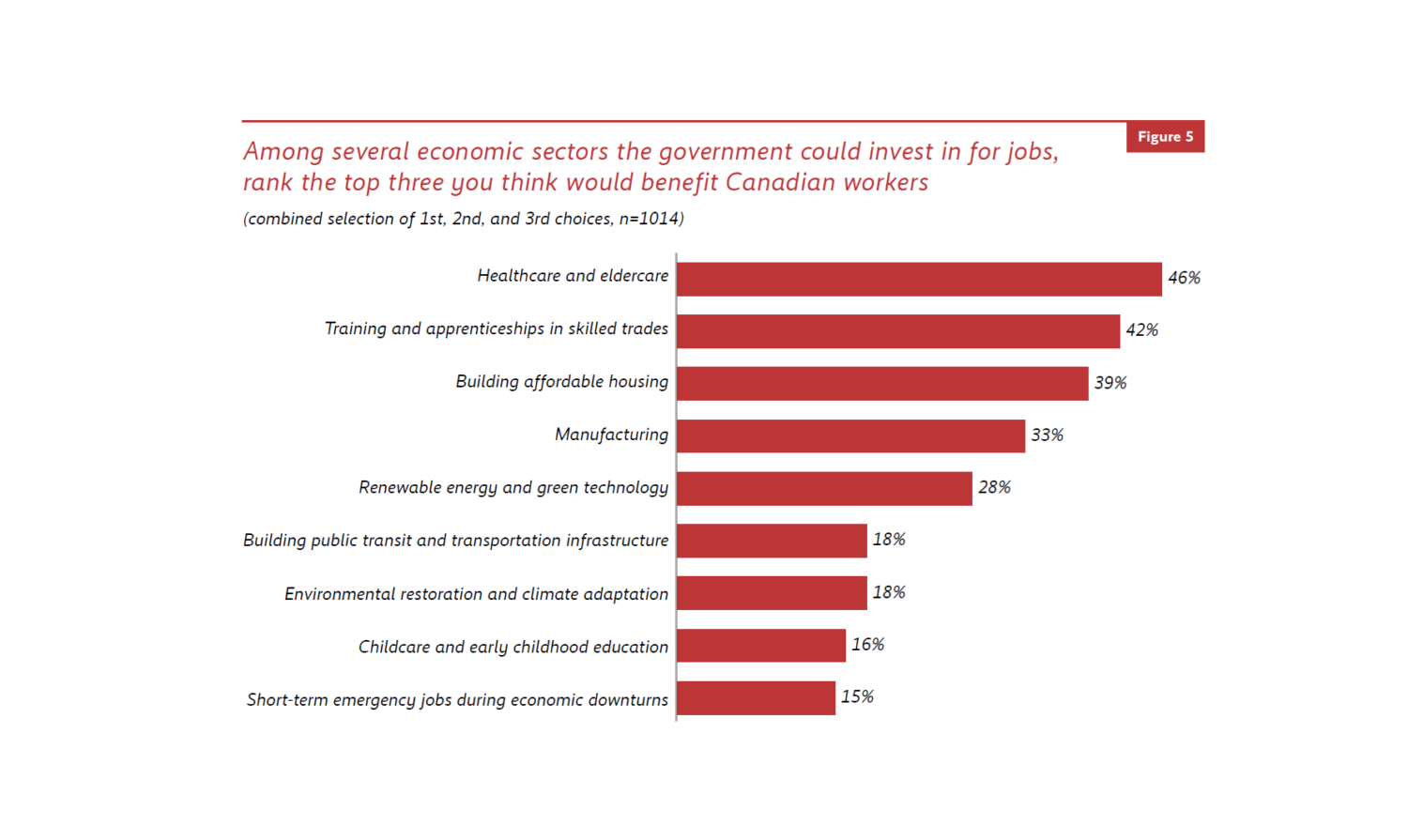
When it comes to what a job creation program ought to look like, respondents prioritize jobs in the care economy, skilled trades, and housing sector. When combining all top 3 rankings, 46% of respondents prioritize healthcare and elder care, 42% prioritize skilled trades, and 39% prioritize housing construction. Raising the minimum wage and improving work-life balance are tied as the top priorities for workers at 37% each.
Without a clear plan to strengthen the sectors Canadians see as essential — including health care and social services – and without visible action to protect workers from the fallout of the trade war, trust in the federal government’s economic stewardship risks further erosion. Growth alone is not enough; Canadians need to see how that growth translates into security.
For social democratic policymakers, unions, and civil society leaders, this research maps the gap between macroeconomic ambition and household security — and points toward grounded, worker-centered policies that can rebuild trust and defend good jobs in uncertain times.