
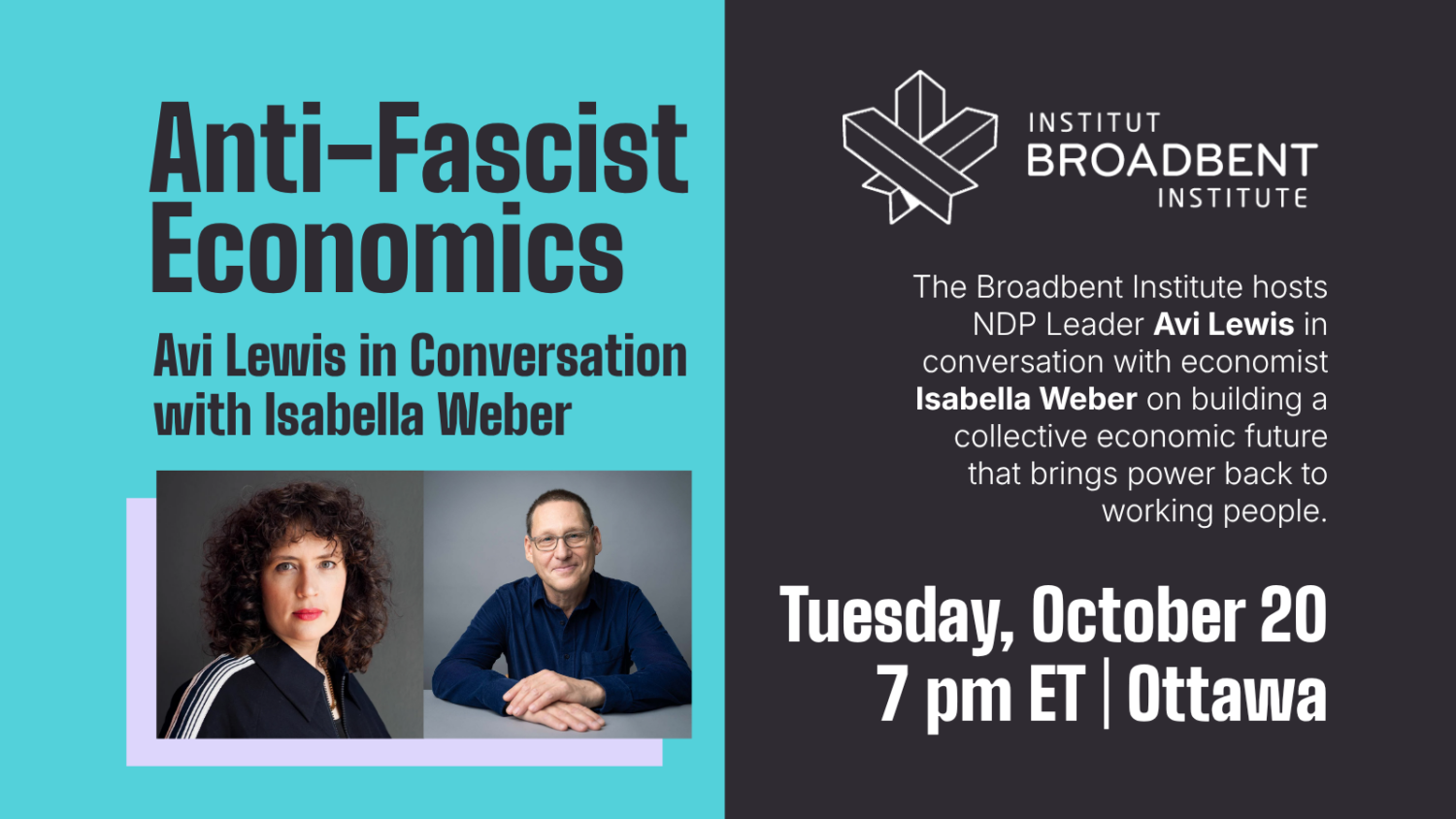
On October 20, join NDP Leader Avi Lewis in conversation with economist Isabella Weber on a democratic socialist vision for Canada’s economy.
Isabella Weber is a German economist and Associate Professor at the University of Massachusetts Amherst whose research focuses on inflation, price stabilization, international trade, and the history and development of economic thought. Her new book, Anti-Fascist Economics: In Defense of Affordability, Dignity, and Democracy (Penguin Random House, 2026), argues that stopping the rise of the far-right will require putting affordability, dignity, essential needs, and democratic control over corporate power at the centre of economic policy.
Avi Lewis, the leader of Canada’s NDP, echoes these calls in the Canadian context, proposing affordability and economic security for working people as the central political offer that Canadians deserve as we move towards an economy of the future.
In a fireside chat, Avi will engage Isabella on her ideas, policy proposals, their application to the Canadian economy, and how we can build the collective economic future that brings power back to working people across the world.
Isabella Weber is the recipient of the Broadbent Institute’s 2024 Ellen Meiksins Wood Prize and delivered her lecture on Profits, Inflation and Survival in an Age of Emergencies at Toronto Metropolitan University on May 30, 2024. Since then, Weber’s research on price caps, buffer stocks, and windfall profits has helped to inform Canadian campaign policy platforms and public debate on how to fight inflation. Her work on anti-fascist economics has been used by the federal governments of Germany and Mexico, as well as Zohran Mamdani’s campaign for Mayor of New York City.
The event takes place at a location to be announced in Ottawa, on Tuesday, October 20th starting at 7pm (doors open 6:30pm). Please purchase tickets in advance. If cost is a barrier, please contact info@broadbentinstitute.ca
Books will be available for purchase with the author available for signing.
This event is only made possible with the generous support of the Rosa Luxemburg Stiftung – New York Office.

About Anti-Fascist Economics
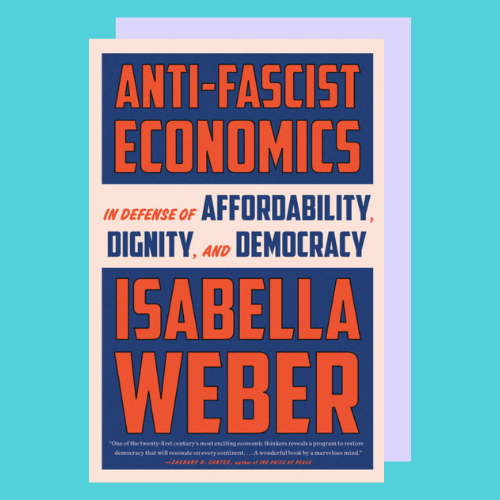
As inequality, inflation, and overwhelming corporate power threaten democracy, a rising-star economist asks what it would mean to create an anti-fascist economics that guarantees dignity for all.
On the night of President Trump’s second presidential victory, economist Isabella Weber tweeted: “Can we now finally have a serious conversation about an anti-fascist economics?” In her view, Democrats had missed the seriousness of the affordability crisis in the wake of pandemic-era inflation. By refusing to step in to protect their constituencies against price explosions in essentials and corporate profiteering, they left room amidst the global crisis for the resurgence of the politics of resentment that Trump and the right reveled in.
Her question, though, was a bold one with implications that reached far beyond one election. In a neoliberal world, we tell people at the same time: Democracy is the highest form of political organization. And: When it comes to the economy, to the material foundation of our life, the best the representatives of the people can do is to subordinate their constituencies to the corporate pursuit of profits. This basic contradiction between the rule of the people and the rule of the market makes neoliberal democracy vulnerable to the threat of fascism, she argues. Economists have too often acted as prophets of market subordination and ended up waxing the slippery slope to fascism. Isabella Weber warns that if we are serious about saving democracy and preventing the further rise of fascists, we need an economics that serves democracy and centers people’s needs and dignity rather than seeing their fulfillment as a welcome side effect in the pursuit of other goals.
In Anti-Fascist Economics, Weber proposes just such a way out. She envisions an economics that centers on essentials for livelihoods and production, that strives to make life on our planet livable for all, that confronts rather than conceals corporate power, and that charts the way towards international cooperation rather than getting stuck in the dichotomy of free trade and trade wars. To halt the further rise of fascism, we need a tangible alternative to the dystopian status quo, she insists, one that takes affordability seriously as a foundation of democracy. In this paradigm-shifting book, Weber recalls a history of mid-twentieth-century economists for whom “never again” was the North star and reinvents their thinking for our day.
Our work is powered by people like you.
We rely on the steady, committed support of individuals who share Ed Broadbent’s vision of a fairer, more equitable Canada. We could not do this work without you, and for that we are incredibly grateful.
The Friends of Progress are our most dedicated supporters, making sure we have the resources to continue championing progressive values within Canada and helping to shape our work through feedback and engagement. Your support gives us the strength to plan ahead, react swiftly to sudden challenges, and stay in the good fight for the long term.