
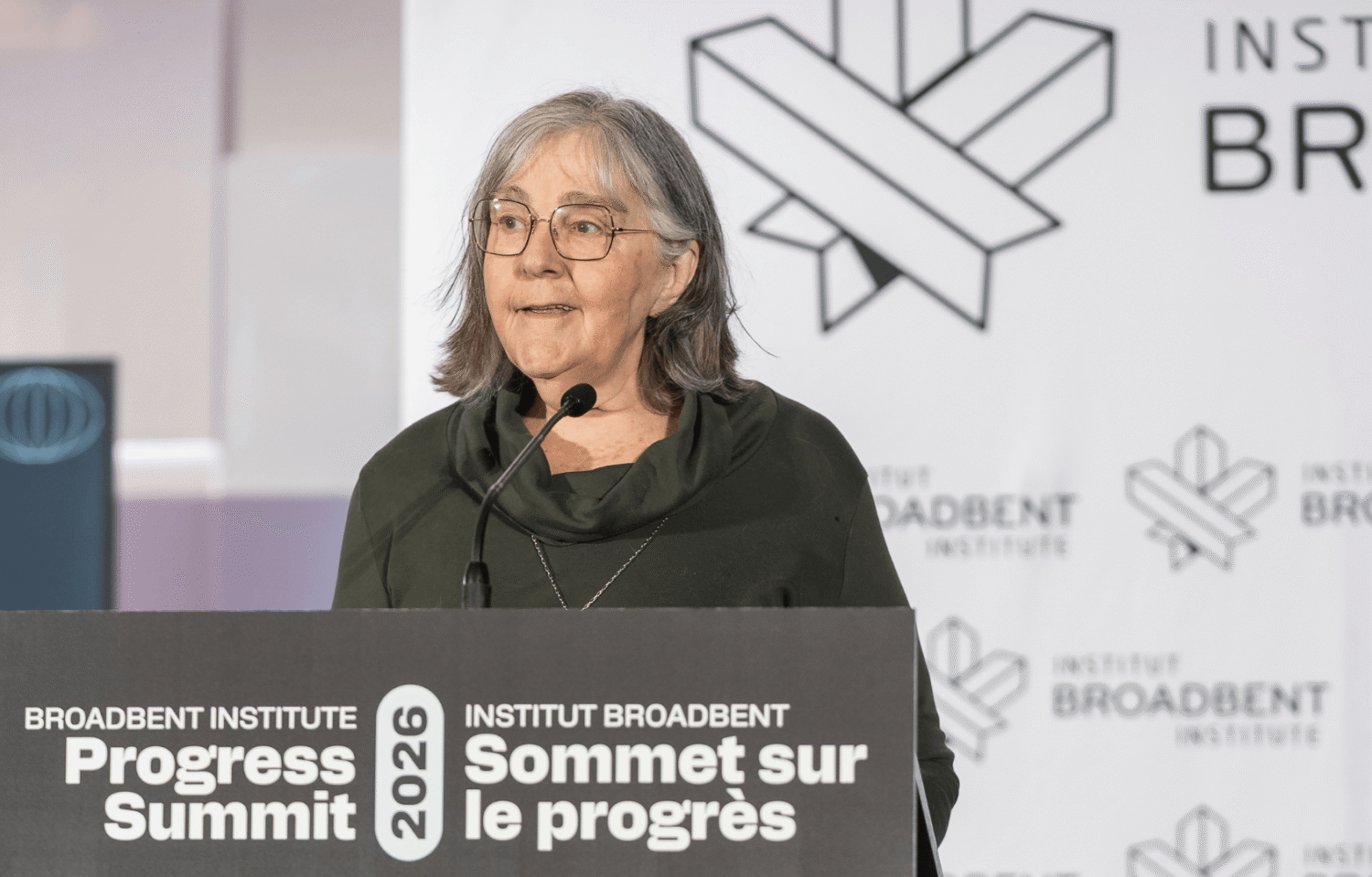
The following remarks were delivered by Frances Abele at the 2026 Progress Summit on Thursday, March 5th in Ottawa. At a session entitled ‘Ed Broadbent: Social Democracy Without Borders‘ Abele and Luke Savage shared insights from the Ed Broadbent Digital Archive Project, bringing forward Broadbent’s internationalist work and outlook.
This seems like a good moment to encourage a discussion of two aspects of Ed’s socialist practice –his commitment to universal human rights, and his attention to the uses of international institutions and international law to protect human communities. He saw these two as necessarily linked. The statements of principles require the application of international institutions and international law to be realized. These are created through political struggle.
For Ed as perhaps for most of us, the apogee of recent world order and human progress was reached in the thirty years after the end of the Second World War. After that hideously destructive global cataclysm, there were scores to be settled, but also lessons learned and preventative measures to put in place. These measures were not abstract policy choices for Ed, but rather integral features of his life experience. He was born in 1936. The adults around him recalled the harsh conditions and the great labour struggles of the 1930s; Ed knew the burgeoning prosperity of the war years in the strong union town of Oshawa and the expanding opportunities of the 1950s and 1960s.
In domestic politics, he saw the gradual elaboration of what is sometimes called the postwar settlement. The settlement involved a set of policies and programs that reflected universal social and economic rights. These were not granted for abstract goodwill reasons. Rather they reflected the economic potential of the overheated postwar economy along with postwar exhaustion and devastation, and importantly, a strengthened labour movement and fears of a postwar depression. In Canada as in many countries, the postwar settlement meant public pension plans, rights for workers and labour unions, child welfare benefits, medicare, an expanded public university system and the other social welfare measures that gradually consolidated a Canadian version of the welfare state.
Thinking internationally, Ed started from a deep appreciation of three innovations of the 1940s: the United Nations Charter, the Universal Declaration of Human Rights and the Bretton Woods Agreement.1 These mid-century agreements were strengthened in 1966 by the International Covenant on Civil and Political Rights and the International Covenant on Social, Economic and Cultural Rights. Together they gave shape to what we came to call the rules-based international order.
All of these new institutions, domestic and international, by design constrained capital and protected people regardless of their personal resources, promoting a fairer distribution of wealth. They did not constitute the new Jerusalem, but all taken together, they had transformative power. They met opposition.
Ed was a sharp observer of the response of capital as it strained against the progressive features of both the postwar settlement and the rules-based international order. He saw struggle ahead. He viewed the accession to power of the neoconservative governments of Margaret Thatcher and Ronald Reagan in the early 1980s as signs that the wrong side was winning, and he was to fight against this turning for the rest of his career. He was proud to say that despite the many flaws of Canadian democracy and the temper of the times, the NDP led by Ed, Audrey, Alexa and Jack did not stumble or dash into the Third Way. And because the NDP did not tilt, Canada did not succumb fully to neoliberalism.
Unlike some, perhaps, in this room — and contrary to the claims of some of his critics — Ed did not seek the abolition of capitalism. I think this had to do with his reading of history, but also it is at least in part because he was disinclined to advocate a leap into the dark. He did not see a path to a productive post-capitalist economy. Instead, for the present, he liked to use the metaphor of a hedge. Let me read a passage from a speech he gave in The Hague in 1995, just at the heart of the neoliberal turn in Canada:
There are many who would have us believe that all thar needs to be done to produce democracy as global reality is to foster market-based economies. And, they add, if you stir international trade with the mix, democracy will come even faster. This of course is not true.
Although market economies at some point do give rise to democratic demands, democracy is by no means inevitable. The rights necessary for market economies to exist are not great in number and are considerably fewer than meet the requirements for democracy. Markets do help entrench the rule of law, they encourage the enforcement of property rights, the mobility of labour and capital, the enforcement of international trade and currency regulations. When it comes to rights, that is all that is functionally required. Modern history has given us many examples of non-democratic countries with thriving market economies meeting these requirements.
Markets, as Adam Smith might have said, have a way of looking out for themselves. However, like a hedge that must be pruned to keep it from running wild, a strong system of checks and balances is necessary. Unless adequate political attention is paid to the process, unless political development is consciously democratic, market economies not only eliminate traditional rights, making a feeling of community extraordinarily difficult to maintain, widen the gap between rich and poor, but also can leave out entirely, certain fundamental democratic rights, e.g. the freedoms of political speech, association and political choice.2
Ed took what proved to be a long break from electoral politics in 1989. Worn out by the free trade election and the disappointment of the NDP’s poor showing in Quebec, he was ready for a change. Responding to the recommendations of a Parliamentary Committee, Prime Minister Mulroney offered him the opportunity to build a new non-governmental organization that would be active internationally. Ed founded and led the International Centre for Human Rights and Democratic Development –later Rights and Democracy–for six years, from 1990 to 1996. It was well-funded and enjoyed both independence and strong diplomatic support.
As he had done many times in his life, Ed worked hard and led with principle, and he had fun. He staffed Rights and Democracy with accomplished and highly motivated young idealists. They worked with unions and grassroots organizations in Central America, Asia and Africa, as well as like-minded international non-governmental organizations. The aim was intelligent support for social justice initiatives and for democratic civil society organizations, explicitly guided by the Universal Declaration of Human Rights.
Occasionally this work involved significant innovation. One project, to support Aung San Suu Kyi when she was under house arrest, brought all living Nobel Peace Prize winners to the Thai border with Burma. Another effort, aiming to build peace in the region, brought together Ministers of Defence from antagonistic Central American countries.3
It is worth remembering that the institutions that were so important to Ed grew out of the grinding misery of economic depression and war. In that context, it was clear to him that movement towards social democracy, or democratic socialism, was the necessary remedy.
In Ed’s last book, which he wrote with Jonathan Sas, Luke and me, he explained his own thinking about the future good society. He saw the need for counterbalancing forces –a strong state able to constantly trim the capitalist hedge, and a strong civil society able to challenge both. Internationally, statements of principle, laws and institutions are essential to enable cooperation among nations and their citizens to keep the peace and spread healthy development. He said:
To be a socialist, after all, is also to be a universalist: committed to the dignity, equality, and rights of every human being regardless of where they were born or on which side of a border they happen to reside.
- Another example: The International Labour Organization (ILO) was an agency of the post-World War I League of Nations. It was subsumed under the new United Nations in 1946, reaching peak influence in the 1940s–1960s. The ILO was awarded the Nobel Peace Prize in 1969 for promoting social justice and international labor standards. ↩︎
- Edward Broadbent, “The Globalization of Market Economies” Debate on Development, Democracy and Human Rights. Netherlands Quarterly of Human Rights 13(3) : 297-311. ↩︎
- Rights and Democracy survived Ed’s departure in 1996, operating until 2012, when it was wrapped up by the Harper government under shameful circumstances. ↩︎