
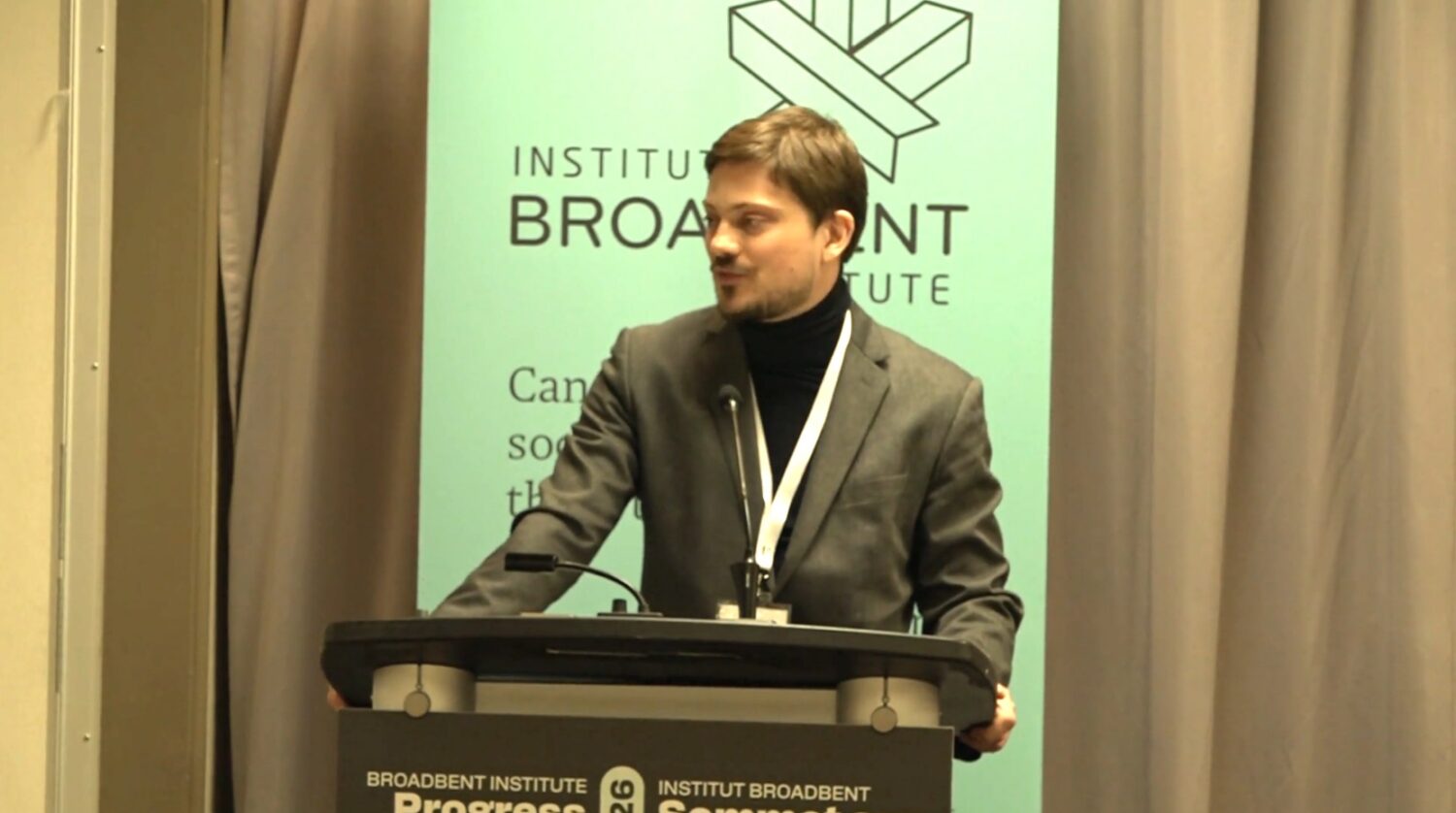
The following remarks were delivered by Luke Savage at the 2026 Progress Summit on Thursday, March 5th in Ottawa. At a session entitled ‘Ed Broadbent: Social Democracy Without Borders‘ Savage and Frances Abele shared insights from the Ed Broadbent Digital Archive Project, bringing forward Broadbent’s internationalist work and outlook.
Good afternoon.
When you read Ed Broadbent’s old speeches, there are certain trademarks that quickly become familiar. And one of these was that — whatever the place, theme, or the context happened to be — there was usually some more general statement of principles on which Ed rested his words. That may partly have been the teacher in him. Maybe a bit of the political theorist as well. But, whatever the reason, Ed Broadbent always tried to impart on his audience more than just the bare facts or prosaic details about which he may otherwise have been speaking.
The upshot was that those who came to hear him talk about inflation, the government’s jobs record, or the NDP’s latest proposals for Medicare, would also be treated to flourishes like this one — a definition of socialism which Ed chose to include in one 1975 speech at a small community hall in Edmonton.
“Socialism,” Ed told his audience,
is an optimistic creed, based on a fundamental assumption of the equal worth of all people, and the greatness of the human society that they can create through their collective endeavours. It is a philosophy of compassion, believing that each is responsible for the welfare of all. It is a doctrine of courage, prepared to challenge those who would maintain privileged positions through the exploitation and oppression of others.
This was Ed Broadbent’s creed as a national politician. But you’ll also notice that his language there doesn’t limit itself to Canadians or to Canada. Above all else, that’s why these words felt like a fitting way to begin this talk.
In the time I have today, I’m going to give you all a short sketch of my late comrade Ed’s engagement in the realm of international affairs. The occasion for that is partly this conference’s official theme, which is “Defending Democracy Across Borders.” And in light of what’s currently happening in the world I would probably have chosen to speak on the question of internationalism anyway.
But when it comes to Ed’s legacy I think this subject is important in and of itself because it is easily the least well-known and least written about aspect of Ed Broadbent’s roughly seven decade career in public life. That, in my opinion, is a serious oversight and, if nothing else, I hope the remarks today by myself and Frances will do some small part to correct it.
Ed Broadbent’s interest in international affairs began very early. As a young man from Oshawa thinking his first political thoughts, he often seems to have looked abroad for political inspiration — finding it in left wing American magazines like The Nation and also in the work of midcentury European writers of the democratic left (his favourites being George Orwell and Albert Camus).
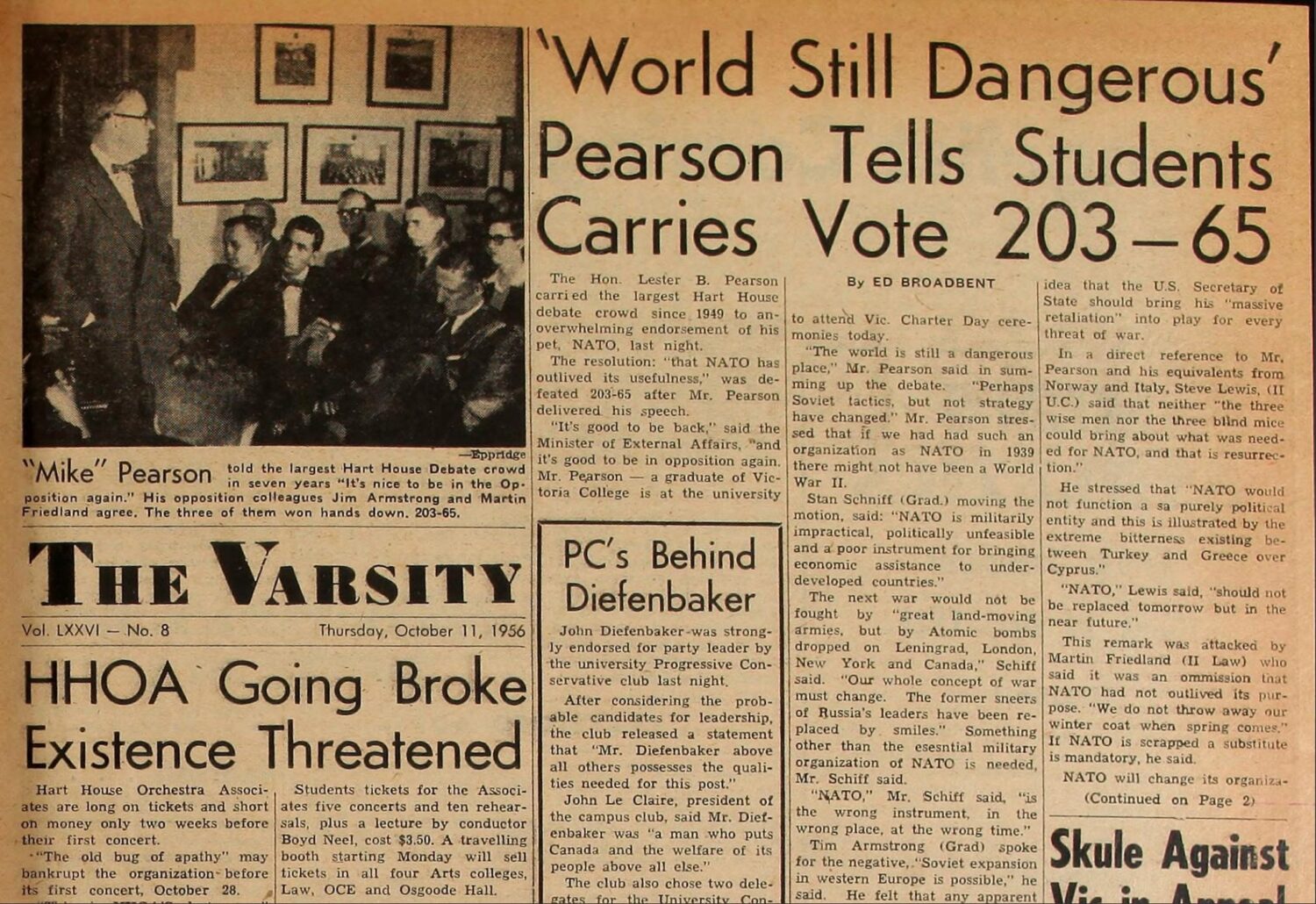
His first published writing on a question related to foreign policy I’ve been able to find comes in the form of a report,1 written in October 1956 while Ed was an undergraduate at the University of Toronto, for its student newspaper The Varsity (incidentally where I got my start as a writer). The occasion for that report was a debate held at Hart House about Canada’s membership in NATO in which Lester B. Pearson faced off against a quite precocious second year student from University College by the name of Stephen Lewis.
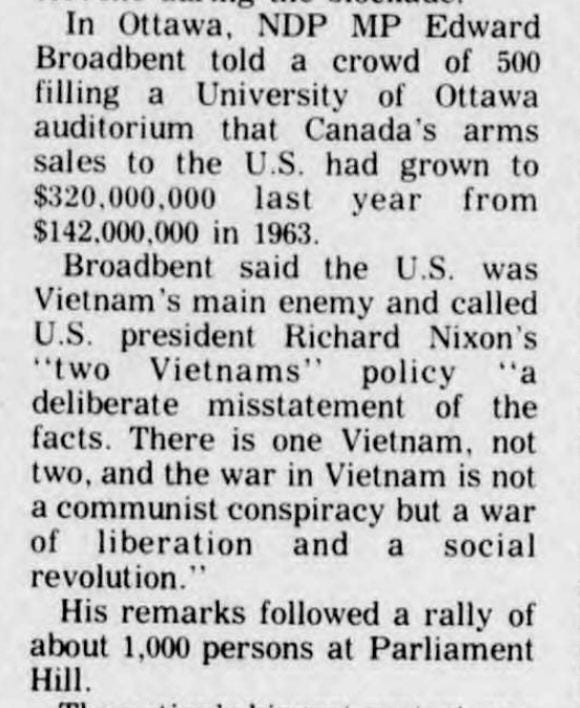
But it was in the 1960s that Ed Broadbent’s ideas about the world really began to take shape. This, after all, was the decade of Paris ‘68, of the New Left, the civil rights movement; of growing global protests against the American war in Vietnam; and, here in Canada, of the Bomarc Missile Crisis, the Waffle, and the Quiet Revolution. And Ed — who in those days sported a leather jacket, drove a motorcycle, and was described in 1967 by one student journalist as a “button-wearing Vietnik” — fit right in. Helping to organize protests against the war in Vietnam while a professor of political science at York, he soon carried his antiwar activism into Parliament. As a keynote speaker at Ottawa’s 1969 Moratorium Day protest, Ed had harsh words for US president Richard Nixon, remarking “[That] the main enemy of the people of Vietnam” was not a communist conspiracy but the military superpower to the south of us.”
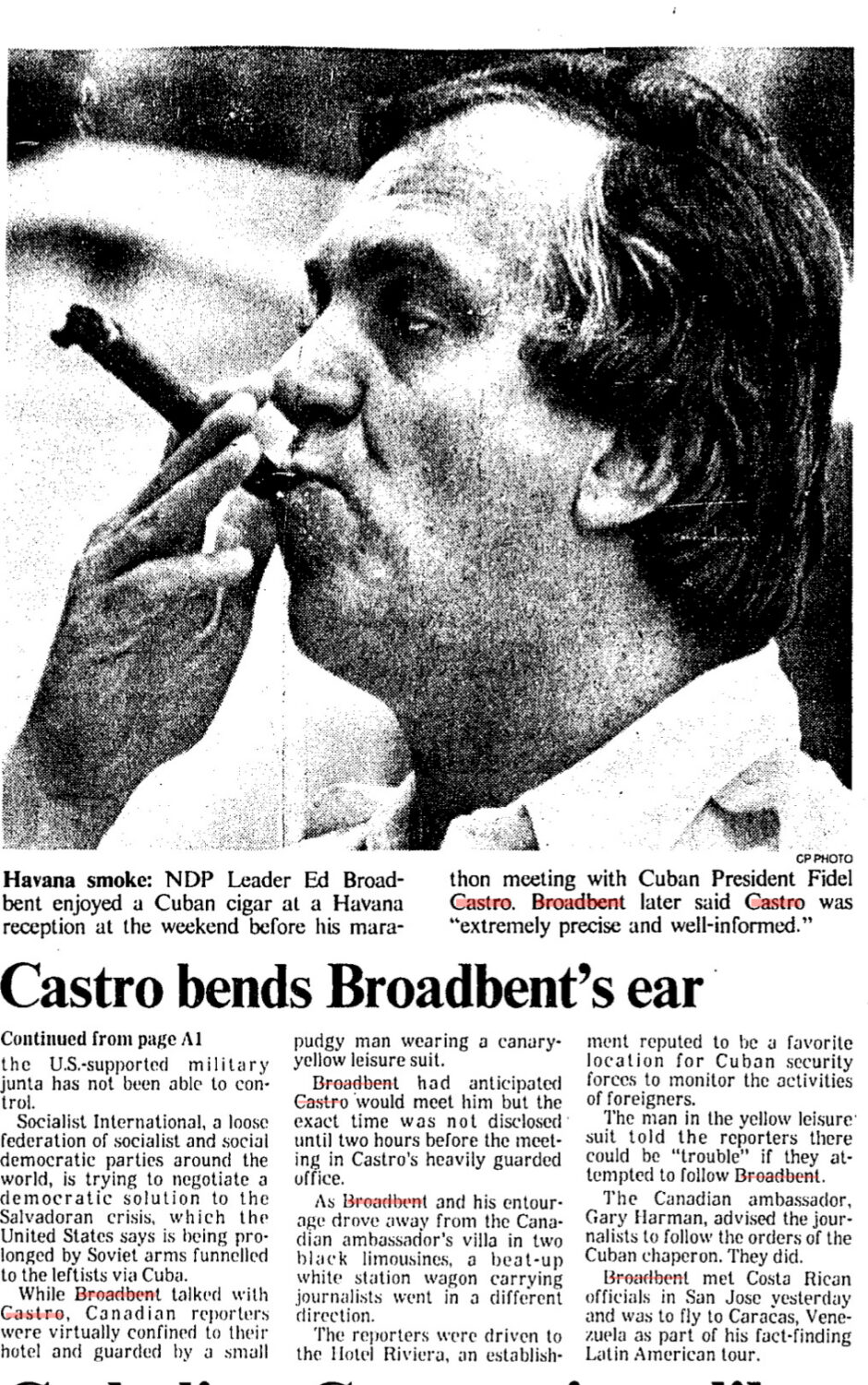
Notwithstanding this history, it should be noted that international affairs was not initially one of Ed Broadbent’s major areas of focus. As a young MP, he was a member of the Canadian delegation to the United Nations and spoke periodically in the House on issues related to foreign affairs, notably the US-backed coups in Chile and Greece. In 1974, in the first of several trips that would see him develop a dialogue with Fidel Castro — and an even greater love of cigars — he visited Cuba and delivered a fascinating report on the trip to an audience in his home constituency of Oshawa.
But as a newly minted MP in the early seventies he was mostly preoccupied with domestic issues — notably the question of industrial democracy (the subject, perhaps, of a future talk). Becoming chair of caucus, and then the NDP’s parliamentary leader in the wake of its 1974 election setback, developments abroad often took a backseat to the more basic task of rebuilding.
Beginning in the late 70s, however, this changed.
Over the next decade, during the height of his popularity as a national politician, both international affairs in general — and a range of Third World causes in particular — became a major and persistent concern for Ed Broadbent. This was evident when Vancouver played host to the 1978 Congress of the Socialist International, a conference which welcomed Nicaragua’s revolutionary Sandinistas as guests (in Ed’s words scaring “the bejesus out of the good of citizens of British Colombia.”) Through the SI, in which he served as vice president, Ed became acquainted with key figures from across the wide spectrum of the global social democratic left: among them Willy Brandt of West Germany (then the organization’s head), Bruno Kreisky of Austria, Swedish prime minister Olof Palme, Gough Whitlam of Australia; and from the Democratic Socialists of America, Michael Harrington and Irving Howe.
The SI was by no means a perfect organization, and as Ed later told me and Frances, it ultimately never became the presence in global affairs some had hoped that it would. In the 1970s and 80s, however, it quite ambitiously sought to establish itself as a third force on the world stage: expanding its membership to include an array of new parties from across Asia, Africa, and the Americas in a bid to create an alternative to the what were then the duelling models of Washington and Moscow.
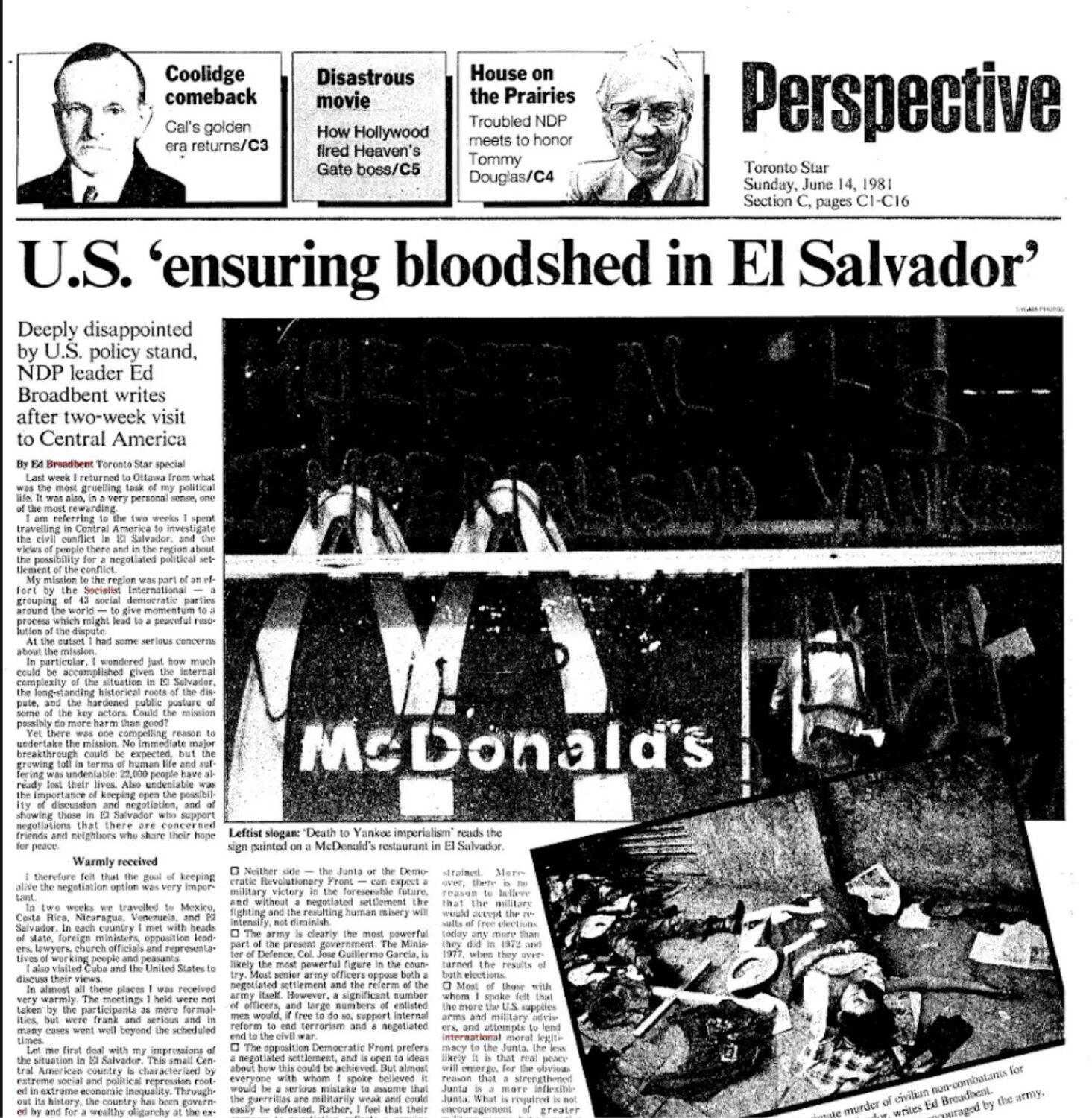
Now, there is simply too much history here for me to be exhaustive in the time that we have here. But suffice it to say that the 1980s saw Ed Broadbent become a loud and vocal advocate for global nuclear disarmament; a passionate student of Latin American affairs; and a fierce critic of the Reagan administration’s anticommunist crusades. In these causes, of course, he was certainly not alone: counting as important allies a crop of others drawn from what was then the new generation of MPs in the federal NDP caucus. And here I’d be remiss not to mention people like Dan Heap, Pauline Jewett, Ian Waddell, Svend Robinson, Bob Ogle, and Jim Manley.
To give you all a flavour of Ed Broadbent’s international engagement during this period, I’d like to read a bit from a speech he delivered just a few short blocks from here in Parliament on October 27, 1983. For context, in just one of its countless acts of aggression in the region, the Reagan administration had just invaded Grenada. The invasion, officially justified on the absurd grounds that the tiny island country somehow represented a security threat to the USA, came amidst the overthrow and brutal murders of Prime Minister Maurice Bishop alongside several of Grenada’s most prominent trade unionists.
Forcefully condemning the action Ed Broadbent warned that the Reagan administration was “turning… the whole of Central America into a crusade against any kind of political regime which can be seen in any sense… to be philosophically left of centre…
It is supporting in this crusade… any kind of regime on the right, providing that it supports the government of the United States… [And if this aggressive behaviour] undertaken against the nation of Grenada… [is allowed to succeed] then I ask, can Nicaragua be far behind? And after Nicaragua, will it be Cuba? After Cuba will it be the Dominican Republic? And after the Dominican Republic, who knows?… Haiti, Guatemala, Nicaragua and the Dominican Republic.
All those countries in our lifetime have had violence inflicted upon them by the United States… These countries have been attacked, have experienced the violence of America’s marines and invariably the argument given was that the purpose was to create the conditions for democracy.
Quite the opposite occurred. After each of these actions of violence… democracy did not grow. Vicious, inhumane dictatorships were what emerged from these invasions — dictatorships that lasted not for a year or two but for decades.
Needless to say, I think those words resonate with a particular force today.
Friends, as we confront the geopolitical realities of our own time, from the unconstrained aggression of the Trump administration across the Western hemisphere and beyond to the still ongoing campaign of genocide being waged against the Palestinians; as we navigate the continued unraveling of a liberal order discredited and undone; as we grapple with our own government’s triangulation on the world stage and the moral torpor with which it has chosen to meet the moment; and as we welcome so many wonderful friends from different corners of the world to this conference, I’d like to conclude my remarks by giving the final word to Ed in the hope that his powerful legacy of human rights and international solidarity can be a source of inspiration to us all in this very difficult and dangerous time.
In 1986, against the backdrop of more US aggression in the hemisphere — this time against Nicaragua) — Ed Broadbent wrote the following. And I really can’t think of a passage that better illustrates his internationalism or, indeed, the vision of a different world that brings us here today.
The world of a politician is a world of light and shadow. Never merely pragmatic, it is always moral. For us in the international social democratic movement there has always been the difficulty of reconciling certain universal principles with their application in a variety of countries with widely divergent histories. It is… difficult — but it must be done.
We apply the principles of equality, liberty, and economic justice constantly within our own nations, of course; this is a difficulty we take for granted. But just as we must make critical judgments at home, so, too, must we [make them] when we look at other countries. Cultural and historical differences must certainly be taken into account, but they never absolve us of the obligation to judge, decide, and act.
When we talk about democracy, pluralism, religious freedom, tolerance, human rights, and self-determination, we are not giving voice to mere abstractions relevant to a only few nations; we are talking about human values and ideals that we believe [to be] desirable for all people, at all times, in all parts of our world.
Thank you very much.
These remarks were originally published on lukewsavage.com
Subscribe for the latest writings and opinions from Luke Savage.
- Ed Broadbent, “World Still Dangerous, Pearson Tells Students, Carries Vote 203 – 65″October 11, 1956. The Varsity (University of Toronto) ↩︎