Table of Contents
Reinforcing Hunters and Trappers Organizations (HTOs): Supporting Arctic Sovereignty through Social Infrastructure is a research project delivered through the University of Ottawa Graduate School of Public and International Affairs’ Directed Research Placement.
McKenna Eve York (she/her/elle) is the author is this report for the Broadbent Institute through the University of Ottawa’s Graduate School of Public and International Affairs’ Directed Research Placement program.
The author would also like to thank MP Lori Idlout, Michaela de Hoop, Christine Ackermann, and Jason Akearok for their instrumental support in this analysis. The Broadbent Institute would like to acknowledge Professor Paul Robinson, UOttawa GSPIA, for his support through the Directed Research Placement.
About UOttawa GSPIA and Directed Research Placement
The UOttawa Graduate School of Public and International Affairs educates highly qualified leaders conscious of their responsibility to the common good in the domains of international relations, public policy, environmental sustainability, security, and defence. The Directed Research Placement is open to full-time MA students in public and international affairs or security and defense studies who are not participating in cooperative education programs (co-op). By securing research internships in non-academic settings, this experiential learning opportunity enables students to acquire core professional competencies and skills to support careers across multiple pathways.
Executive Summary
Defending Arctic sovereignty requires Canada to fulfill social responsibilities for the people living in this region. As a result, Nunavut stands at a geopolitical crossroads amid a shifting international order. The combination of geopolitical tensions, coupled with climate change, food insecurity, democratic deficits, and poverty among Indigenous northerners, all contribute to Canada’s broader vulnerabilities, and must be addressed to strengthen sovereignty.
To this end, the following research aims to articulate the link between the reinforcement of social infrastructure for Nunavummiut to strengthen Arctic sovereignty. The need to address the longstanding infrastructure gap for northerners underscores the key role that Inuit play in Arctic sovereignty. As Mary Simon wrote, before her Governor Generalship beginning in 2021, the process of promoting Canada’s sovereignty in the Arctic ought to “[involve] establishing constructive partnerships with Inuit” (Simon, 2009, p. 251).
This report examines the vital role that Hunter and Trappers Organizations (HTOs) play in securing sovereignty and prosperity of Nunavut and the Canadian Arctic. HTOs are important for Inuit and Nunavut as they maintain the sustainability of hunting and harvesting activities, regulate practices, and manage economic development opportunity from marine and wildlife resources. Using qualitative analyses and a comprehensive review of existing literature—including current defence policy frameworks, the Nunavut Land Claim Agreement (NLCA), data from previous stakeholder engagement, and data from independent researchers—this report aims to assess the needs of HTOs, highlight their chronic under-resourcing, and determine what their resourcing ought to include.
To better assess the current funding framework for HTOs in Nunavut, this report begins with three guiding research questions:
- What resources are required by HTOs in Nunavut to support their operation at full capacity and delivery of programming?
- What size funding package would federal stakeholders need to provide to HTOs?
- What would be the projected benefits of adequate funding for HTOs?
Arctic sovereignty is predicated upon healthy, well-resourced Inuit communities. This report provides a comprehensive overview of the acute service gaps for Nunavummiut and HTOs, thereby illustrating the important link between the development of social infrastructure and sovereignty.
Introduction
As Canada navigates the shifting international order, Nunavut stands at a geopolitical crossroads—mounting concerns for international security and Arctic sovereignty have dominated policy discourse in Ottawa. The federal government’s regional strategies including Arctic and Northern Foreign Policy Framework, the Arctic Foreign Policy, and more recently Our North, Strong and Free (ONSAF), all developed within the last several years, highlight new concern for the Canadian Arctic. Climate change, for example, is having devastating impacts on the Arctic’s ecosystem and has intensified social and economic issues. The recession of permanent sea ice has also contributed to the “opening up” of Arctic seaways. To strengthen Canadian security and democracy against threats originating from external actors, the federal government should adopt an integrated social policy framework that honours its commitment to Inuit socioeconomic wellbeing and sovereignty.
The Department of National Defence’s ONSAF framework outlines several concrete measures through which Canada aims to reassert its military presence in the North. In this context, existing policy frameworks adhere to “sovereignty” in a very traditional sense, defined narrowly by military terms. This report, however, aims to interrogate Canada’s current posture toward its Arctic security apparatus and expand traditional conceptions of security to include the health and prosperity of Inuit communities. To do so, the following discussion maintains that a sovereign and secure Arctic is predicated upon healthy, democratic, and well-resourced Inuit communities. To achieve its policy goals as stipulated in the ONSAF framework, Canada ought to adopt an integrated policy framework that honours its commitment to Truth and Reconciliation by contributing to social infrastructure for Inuit.
This report provides a comprehensive qualitative assessment of existing literature and data from previous stakeholder relations to clearly articulate the link between Canada’s defence policy vision and its fiduciary duty to Indigenous peoples. As the Arctic region’s geopolitical situation intensifies, policy practitioners in Ottawa must promote the prosperity of Inuit and, as a corollary, assert Canadian democratic sovereignty.
In summary, this report provides an in-depth examination of the critical roles that HTOs play across Nunavut in supporting communities, wildlife, and the Arctic ecosystem. The benefits of healthy and well-resourced Inuit communities are far-reaching—including improved public health, enhanced wellbeing, and increased economic prosperity. By dismantling the traditional conceptualization of security that prevails in the federal government’s Arctic policy frameworks, this research operates on an epistemic recentering of Canada’s approach to defending democracy and Arctic sovereignty.
The NCLA is an agreement between Inuit of the Nunavut Settlement Area, as represented by the Tungavik Federation of Nunavut, and the Government of Canada. Signed on July 9th, 1993, it is the largest land claims settlement in Canadian history and enabled the subsequent creation of Nunavut and the Government of Nunavut in 1999. The agreement stipulates the democratic right for Inuit to participate in “decision-making concerning the use, management and conservation of land, water and resources,” wildlife harvesting rights, “financial compensation and means of participating in economic opportunities,” and, “cultural and social well-being” (Government of Canada, Tungavik Federation of Nunavut, 1993, p. 1). Legally and contractually, the Government of Canada is obligated to uphold its commitments to fulfill its fiduciary responsibilities to Inuit of Nunavut. HTOs are one type of recognized local Inuit organization that works with Nunavut Institutions of Public Government (IPGs) to facilitate co-management of lands, resources and waters.
The Role of HTOs
Article 5.7 of the NLCA, titled “Special Features of Inuit Harvesting,” provides an overview of the roles and responsibilities held by HTOs. The agreement stipulates that each community in Nunavut shall have an HTO, with membership open to all Inuit residents in the community. At present, there exist 25 such organizations in Nunavut. Under Article 5.7.3, the functions of HTOs include the following:
- “The regulation of harvesting practices and techniques among members, including the use of non-quota limitations;
- The allocation and enforcement of community basic needs levels and adjusted basic needs levels among members;
- The assignment to non-members, with or without valuable consideration and conditions, of any portion of community basic needs levels and adjusted basic needs levels; and
- Generally, the management of harvesting among members” (Government of Canada, Tungavik Federation of Nunavut, 1993, p. 46; Polar Knowledge Canada, 2024).
More concretely, HTOs play substantial roles in key community and economic activities. These informal activities can be categorized as follows:
- The provision and sale of country food and hunting and trapping equipment’
- Information management (collection, storage, and dissemination of information);
- Public health initiatives; and
- Miscellaneous or ad-hoc projects.
Provision of Country Food, Hunting, and Trapping Equipment
In addition to their administrative responsibilities as stipulated under Article 5 of the NLCA, HTOs serve as a hub for community engagement and play a key role in community health and wellness. The sale and provision of fresh country food provide increased access to nutrition and helps to promote cultural connectivity among community members. Some of these country food items include maktaaq (whale skin and blubber), caribou meat, and pissi (dried Arctic char). These items are generally sold at an affordable price relative to those in grocery stores, which will be discussed in detail in the following sections. Moreover, HTOs facilitate the sale of hunting and trapping equipment. These materials include gill nets, various knives (skinning, bait chopper), and sled runners. These product sales are often communicated by HTOs to community members via Facebook which is actively used to share information.
Information Management
HTOs facilitate draws for polar bear hunts and communicate various hunting opportunities publicly to their members. The head offices are also responsible for maintaining up-to-date and accurate wildlife harvest trackers to ensure that marine mammals are being harvested at sustainable levels. HTOs ensure that they uphold their commitment to the NLCA and to their communities by managing important information. For sharing this information with community members, Facebook is generally the first line of communication between the organization and individuals.
Public Health: Trichinella Test Kits
Trichinella (Trichinella nativa) is a nematode parasite that can infect mammals, as well as some birds. In the context of the Canadian Arctic, Trichinella has been known to infect a multitude of wildlife, including polar bears, foxes, wolves, walrus, and seals. Recently, Trichinella has adapted to Arctic conditions and can survive in infected muscle tissue long after an animal has been harvested, even if it has been frozen (Polar Knowledge Canada, 2024). Those who consume uncooked or frozen meat from an infected animal may become sick with a disease called Trichinellosis (sometimes also referred to as Trichinosis), which requires specialized medical treatment.
To mitigate these risks, particularly for Nunavummiut, Nunavut Arctic College and Nunavut Tunngavik Incorporated (NTI) have collaborated on the development of a diagnostic procedure designed to detect Trichinella larvae in wildlife. The diagnostic test kit, developed by the Canadian Food Inspection Agency (CFIA), was implemented in 2017 and has since been operated by community members, alongside researchers from the Nunavut Research Institute (NRI) and the NTI. In 2023, the Nunavut Arctic College’s laboratory in Rankin Inlet was equipped with resources to provide further Trichinella detection services to Inuit, eliminating barriers to accessing timely detection services for Kivalliq communities (Nunavut Research Institute, n.d.).
HTOs have been made partly responsible for the distribution of these kits to community members, free of charge. Because the wider initiative of the provision of Trichinella test kits is carried out in conjunction with the CFIA, the test kits are distributed to organizations in Nunavut free of charge. Additionally, flyers and brochures are shared regularly on HTO Facebook pages to encourage members to remain vigilant with obtaining samples to send to the laboratory for testing. Moreover, and according to the Nunavut Research Institute, Nunavut Tunngavik Incorporated pays harvesters $150 for each sample submitted to help encourage participation in the program (Nunavut Research Institute, n.d.). At the level of individual HTOs, some organizations will provide additional compensation to their members for each sample provided for testing, at their discretion.
Land Use and Preservation
In the context of Nunavut, HTOs are integral in fulfilling the articles of the NLCA, providing insight and expertise to Nunavut IPGs on regulating harvests, land use and resources, as well as water and wildlife management like the Nunavut Wildlife Management Board (NWMB). Each regional HTO, on behalf of the NWMB, manage the harvesting done by their members. The local HTO also sets the rules for Inuit harvesting in their respective area, separate from non-Inuit who must follow the rules set be Nunavut Government. (Nunavut Tunngavik Incorporated, 2004) HTOs are also able to make claims for harm to wildlife under the NLCA when there is proof that a developer has harmed Inuit or fishing in an area and can represent individual claimants for damages to hunting traps and other equipment in disputes handled by the Nunavut Surface Rights Tribunal.
While HTOs are best equipped and positioned for these land use and preservation activities, they largely lack the resources for engagement with other IPGs such as the Nunavut Planning Commission (Lochead, 2022). HTOs have long indicated the lack of resources available to carry out this capacity outside of normal operations, such as the creation of reporting and engaging in consultations to inform land use planning and preservation initiatives in a timely manner. For HTOs to fully participate in engagement with federal stakeholders, important roles like technical writers and accountants would require an increase in the organizations’ operational capacities outside of regular operations. Lack of funding translates into lack of preparatory capacity, ultimately preventing Inuit from participating in projects that directly affect their traditional territory.
Miscellaneous or ad-hoc Projects
In addition to overseeing the hunting and trapping activities of the community, HTOs take part in ad-hoc initiatives to promote the well-being of Inuit by partaking in fundraising events for students and youths. HTOs engage in community organizing, bringing members together as an institution for public education and health. Other initiatives include conducting guided tours for visitors, which requires increased time and resources from HTO staff.
Facts and Figures
Within the framework of the NLCA, the Government of Canada has an obligation to ensure that HTOs have enough resources to carry out their operations and programming. Under the current funding framework, HTOs are extremely under-resourced and, between organizations, receive the same amount of funding, regardless of total membership, organization size, and geographic size of the region/community they are responsible for.
In November 2025, MP Lori Idlout expressed that the recently reported funding for the Nunavut Wildlife Management Board included approximately $21 million total for the fiscal year, shared among all 25 HTOs and three Regional Wildlife Boards (Parliament of Canada, 2025). This is consistent with Schedule 3-1 of the 2024-2034 Nunavut Implementation Contract, included below, where each HTO across Nunavut received an average of $700,000 per year to cover all operations, salaries, programming, etc.
Table 1 – Schedule 3-1 of the 2024-2034 Nunavut Implementation Contract
HTO Organizational Structure and Salaries
Using these figures as a framework, the following analysis requires several important assumptions. First, the following calculations utilize Nunavut’s most up-to-date minimum wage of $19.75 per hour, as of September 1st, 2025 (Government of Nunavut, 2025). It is also assumed that employees in the office of an HTO work full time-roles (40 hours per week), for 50 out of 52 weeks of the year. Therefore, a salaried employee of an HTO earning minimum wage in Nunavut would earn approximately $39,500 per year, before tax.
To minimally fulfill their operational requirements, each HTO requires at least two full-time staff members and a custodian in the head office to manage the administration and delivery of programming. Additionally, each organization has a board with several committee members. The boards are generally composed of a Chair, Vice Chair, Secretary, Treasurer, and 5 regular members. All board members earn a fixed amount per meeting in the form of an honoraria.
Currently, most HTOs convene twice per month. However, it is recommended that each organization convenes three times per month to ensure that board members can dedicate ample time to discussions that have direct impacts on the health and well-being of Inuit.
Table 2 provides an overview of a typical HTO organizational structure and the amount of its total funding that solely compensates its salaried employees. It is important to note, however, that the minimum wage in Nunavut is not necessarily a living wage, and employees ought to earn enough to cover their needs and those of their dependents. This contingency will be expanded on in the following sections.
Table 2 – Overview of HTO Personnel and Pay Schedule
Inflation and the Living Wage in Nunavut
This section provides an analysis of two major components in the calculation of a living wage in Nunavut—food and accommodation. Inflated food prices contribute to high rates of food insecurity, and the lack of affordable, adequate housing puts thousands of Inuit families at risk each year.
Housing
The Northern Housing Report (2023) by the Canada Mortgage and Housing Corporation (CMHC) shows that approximately 49% of families in Nunavut cannot affordably secure market housing. At minimum wage, nearly 7,000 families in the Iqaluit region alone, “cannot affordably secure any market option” (Canada Mortgage and Housing Corporation (CMHC), 2024, p. 26).
For example:
- Renting a bachelor unit requires an annual income of at least $75,000;
- Renting a 1-bedroom unit requires an annual income of at least $102,000;
- Renting a 2-bedroom unit requires an annual income of at least $116,000; and
- Purchasing a detached single-family home requires an annual income of at least $164,400 (Canada Mortgage and Housing Corporation (CMHC), p. 26).
Food
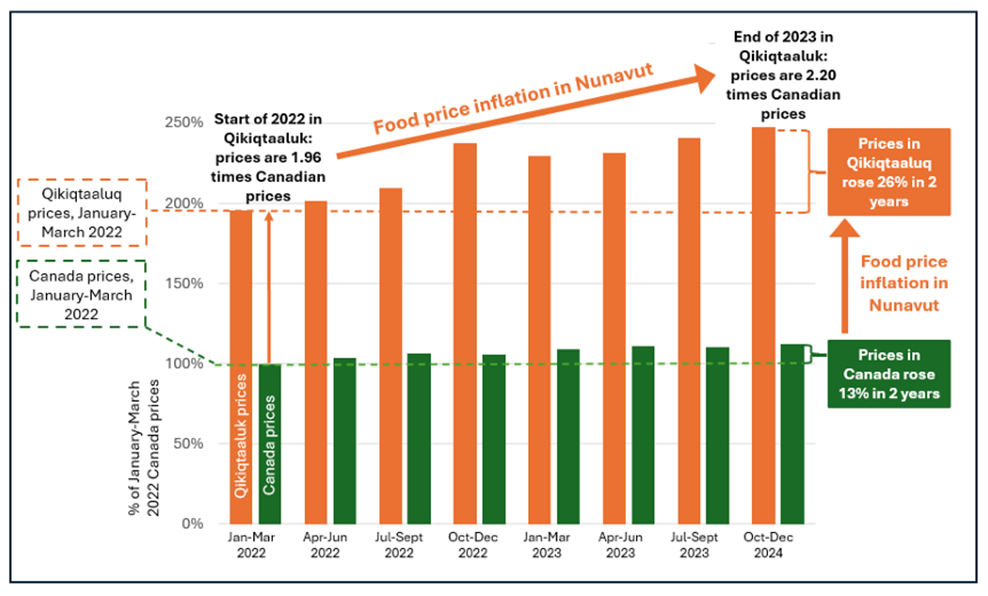
Similarly, food price increases in Nunavut in 2022 and 2023 demonstrates that during that time frame, prices in the Qikiqtaaluk region rose 26% in 2 years, whereas the average food prices in Canada saw an increase of 13% (Li, 2025, p. 3). The increased inflationary burden in Nunavut communities on food prices weighs heavier on the cost of living than in Southern Canada as demonstrated by Table 3 and Figure 1.
Table 3 – Comparison of Food Price Inflation Between 2022 and 2023 (Li, 2025)
Figure 1 – Relative price levels based on a basket of 23 closely matched food products
According to the Royal Bank of Canada, in 2024 the average monthly household expenditures on groceries for a family of four was approximately $1,227.00 (Royal Bank of Canada, 2024). To account for the higher average family size in Nunavut, the northern cost of living would be assumed to include on average $1,500 in monthly grocery expenditures. However, adjusted for food price inflation in the north, this amount can double, or even triple, leaving an Inuit family of 5 spending $4,500 per month on groceries (Fawcett-Atkinson, 2024; Chan, et al., 2006).
In February 2024, the CBC reported on a former employee of the North West Company, the largest grocer in Nunavut, who spoke out on the exorbitant inflation of grocery prices in the territory. The article highlighted that one litre of olive oil retailed for $36.59, compared to the same product from Loblaws for $18.00 (Loblaws, n.d.; D’Souza, Guerriero, & Angelovski, 2024). As a result, the cost of groceries in Nunavut has contributed to endemic food insecurity, where the territory’s minimum wage does not meet the cost of food and housing.
Living Wage Calculation
Cameron, Petiti, and Tedds (2024) highlight the unique mix of “dynamics, tensions, and complexities” among the Nunavut jurisdiction (p. 313). With Inuit composing most of the territory’s population (84.3%), Nunavut is the least populous but fastest-growing jurisdiction in Canada, as well as the youngest population (Statistics Canada, 2021). Many Inuit experience the cumulative effects of intergenerational trauma, manifesting today through heightened rates of suicide, addiction, and crime (Cameron, Petiti, & Tedds, p. 313). The labour market in Nunavut possesses limited employment opportunities, which also contributes to higher-than-average unemployment rates among Inuit.
These intersecting socioeconomic disparities contribute to an inequitable reality for Inuit. Despite researchers and advocates calling for the implementation of a basic income for Indigenous northerners, federal stakeholders have failed to address the cost-of-living crisis for Nunavummiut. To this end, this section leans on existing literature to construct a living wage model that accounts for the unique lived experiences of Nunavummiut (Cameron, Petiti, & Tedds, 2024).
In August 2025, the Canadian Centre for Policy Alternatives (CCPA) published “2025 Living Wages for Newfoundland and Labrador, Nova Scotia and Prince Edward Island: Too many workers struggle to make ends meet”. The researchers conducted an analysis of the cost of living among the various Atlantic regions and, using those trends, calculated a living wage budget. Based on this conceptual framework, an approximate living wage in Nunavut can be determined.
The calculation involves establishing a basic basket of goods and services that enable a household to meet its basic needs. Using the living wage budget, the formula thereby helps to determine what a household ought to earn annually to cover those expenses.
The formula is as follows:

(Sandí, Saulnier, & Williams, 2025, p. 13)
Reference Household in Nunavut
To determine the cost of living in Nunavut for a living wage model, the total annual income required to cover the needs of a family in Nunavut for a full year serves as a reference household.
Nunavut has maintained the highest average of people per private household in Canada, correlated to the higher-than-average population growth rate and age (Nunavut Bureau of Statistics, 2012; Statistics Canada, 2021). For the reference household, this model assumes two working parents and three young children, two of whom require childcare, as assumed by Statistics Canada assessments of a family in Nunavut. The costing model of this reference households assumes six categories of household expenditure for this reference family:
- Food: An assumed $4,500.00 per month on nutritious groceries for a young family of 5 (Fawcett-Atkinson, 2024; Chan, et al., 2006).
- Clothing and outerwear: This budget accounts for clothing and footwear “for school, work, and play, including replacement costs for growth and wear” (Sandí, Saulnier, & Williams, 2025, p. 13). A report from Statistics Canada from June 2023 offers a construction of a similar Market Basket Measure (MBM), with specific applicability to Nunavut. The pricing methods outlined in the report approximate the total budget for the reference family to clothe itself, the total being approximately $6,500.00 per year. The MBM for Nunavut accounts for both traditional and non-traditional clothing and outerwear (Devin, Gusajtis, & McDermott, 2023, p. 12).
- Shelter: Includes the rental of a 3-bedroom accommodation, the cost of base-level tenant insurance, and utilities, such as water, gas, and electricity. For the purpose of this report, this cost would be at least $3,330.00 per month (Canada Mortgage and Housing Corporation, 2024, p. 28).
- Transportation: Adjusting for the costs and conditions that are unique to Nunavut, the MBM for Nunavut produces an approximate amount for the “[purchase, operation, and maintenance] of a new mid-quality range All-Terrain Vehicle (ATV) and a snowmobile” (Devin, Gusajtis, & McDermott, 2023, p. 18). This calculation takes into account the average cost of gasoline by utilizing data from the Government of Nunavut Petroleum Product Division’s retail price list for 2018. In the Baffin region, excluding Iqaluit, this cost exceeds $11,250.00 annually (p. 18).
- Childcare: In 2023, the Government of Canada and the Government of Nunavut announced a three-year plan to develop the early learning and childcare services in the territory. Among those investments, the Government of Nunavut maintained its $10-a-day program for licensed childcare (Employment and Social Development Canada, 2023; Government of Nunavut, 2023). This would include full-time, full-year childcare for two of the three children in the reference household, save for the two weeks of vacation from the working parents. In total, this budget item would be a total of approximately $5,000 per year for both children with childcare needs.
- Household expenses: This item accounts for miscellaneous expenses not covered elsewhere, and includes communication needs, such as a cellphone. Bell, as the largest provider in Canada and with service in all 25 communities in Nunavut, provides cell phone plans averaging between $80.00 and $100.00 per month per device (Bell, n.d.).
Table 4: Visualization of the Approximate Cost of Living Annually in Nunavut
Therefore, the living wage calculation follows:

2 EI rate of 1.64% annually, CPP rate of 5.95% annually (EI Premium Rates and Maximums, n.d.) (Government of Canada, n.d.)
At minimum wage, the reference family’s annual expenses should be $85,004, which is far from what this annual family budget looks like. With an average total of all household expenses for a young family of 5 in Nunavut, the total approximate income required for two working parents to meet basic needs should be approximately $130,000.00 annually, or $31.25 per hour for each working adult. Therefore, the living hourly wage for the reference family in Nunavut ought to be at least $31.25. For HTOs where possibly one household adult is a staff member, this would also assume that the other parent has employment elsewhere, with wages of at least $31.25 per hour.
Adjusted HTO Organizational Structure and Salaries
This section compiles data demonstrating the profound challenges associated with the high cost of living in Nunavut. Adjustments for the living wage reveal that individuals earning the current hourly minimum wage of $19.75 per hour cannot afford the cost of living for an average household. Within this framework, the table below of HTOs’ organizational structures, which accounts for the application of a living wage, demonstrates that approximately 44% of the organization’s annual funding would account for payroll alone. Additional positions have been included to account for operational needs that remain unmet under the current funding model, such as a technical writer and a bookkeeper.
As a result, HTOs have approximately $389,800 remaining to account for all other costs associated with the organization’s operations, programming, delivery of services, maintenance, and other initiatives that they undertake to support their communities. Put simply, these figures clearly illustrate the severe under-resourcing of HTOs in Nunavut.
Table 5 – Overview of HTO Personnel and Pay Schedule, Adjusted for the Living Hourly Wage of At Least $31.25
Additional Operational Expenses
Transportation Operational Costs
Apart from the expenses associated with the compensation of salaried employees and board members of HTOs in Nunavut, this section will lean on existing literature from Devin, Gusaktis, and McDermott (2023), specifically their research on the MBM for Nunavut. The MBM’s transportation threshold accounts for the ownership and operation of an All-Terrain Vehicle (ATV) and a snowmobile. The proposed methodology utilizes a model that includes an average fuel efficiency of 17.5 L per 100 km and approximately 3,400 km of driving annually (Devin, Gusajtis, & McDermott, 2023, p. 18). As 595 L of gasoline would be consumed annually at that distance, and as Nunavut gas prices, some of the highest in the country, on average $1.66 per L, approximately $987.70, or a budget of $1,000 per vehicle, would be needed for fuel costs (Corporate Fleet Services, 2025).
With this model, the maintenance and operation of these vehicles would cost approximately $11,245 per year in the Baffin region, excluding Iqaluit (Devin, Gusajtis, & McDermott, 2023, p. 18). To scale this figure to account for a larger fleet of vehicles required for an HTO, this report will assume that each organization maintains an operating fleet of 2 ATVs and 2 snowmobiles. The general maintenance costs associated with both the snowmobiles and the ATVS would include one tune-up and one oil change for each vehicle. For the Baffin region, excluding Iqaluit, these costs are adjusted upwards by 25% to account for the higher maintenance costs found outside the capital (Devin, Gusajtis, & McDermott, 2023, p. 18)
Table 6 – HTO Transportation Annual Operational Costs, Snowmobiles
Table 7 – HTO Transportation Annual Operational Costs, All-Terrian Vehicles (ATVs)
A similar model has been utilized to calculate an approximate budget for two Ford F-150s. The proposed methodology utilizes a model that includes an average fuel efficiency of 16 L per 100 km and approximately 5,000 km of driving annually (Tom Wood Ford, n.d.). As 735 L would need to be consumed annually, approximately $1,223.00, or a budget of $1,500.00 per vehicle would be needed to account for fuel costs (Corporate Fleet Services, 2025). Additionally, an estimated annual repair cost of at least $788.00 is included in the overall operation costs, with a budget of $1,000.00 (Repair Pal, n.d.). The annual operational costs for fuel and maintenance would not include the cost of purchasing a new vehicle between $50,000 and $70,000 depending on the model and shipping requirements.
Table 8 – HTO Transportation Annual Operational Costs, Pickup Trucks
Finally, the same methodology may be applied to the ownership, operation, and maintenance of two motorboats used for maritime transportation. For this analysis, the following calculation determines the approximate fuel efficiency of a typical FourStroke model outboard engine.

(Alberni Power & Marine, 2024)
Gasoline, on average, weighs approximately 731 G per Litre (6.1 lbs per 1 gallon), where an “adequately maintained FourStroke engine burns approximately 0.5 pounds of gasoline every hour per horsepower unit” (Alberni Power & Marine, 2024). In the case of a 105 HP Mercury FourStroke outboard engine, the formula may be rewritten as follows, utilizing an average fuel price of $1.66 per L (Corporate Fleet Services, 2025). With a forecasted price of $15,974.40 annually for fuel per vessel, the following table utilizes a budget of $16,000.00. Additionally, an assumed $1,000.00 has been allocated for annual maintenance of the outboard engines.

Table 9 – HTO Transportation Annual Operational Costs, Motorboat Outboard Engines
Internet Connectivity
Generally, internet connectivity represents an acute gap in infrastructure for Nunavummiut, particularly for HTOs with increased technical requirements and rely on social media platforms like Facebook to connect with membership and communities. Telesat and Starlink are satellite internet constellation systems that provide high-speed, low-latency capabilities to deliver reliable broadband internet. These services are largely used among rural and remote communities, and especially across Nunavut where terrestrial telecommunications infrastructure is limited.
Dependent on the size, membership, and operations of an HTO, organizations in Nunavut may have varying connectivity needs. For a global priority service plan, however, 1 TB of data per month would deliver connectivity over land and ocean, as well as fixed and in-motion use which HTOs would use for a variety of services, from point of sale, to members meetings, to community notices. With this internet connectivity configuration, an HTO would pay $1,670 per month, or $20,040 annually, plus various setup and hardware fees.
Point of Sale (POS) System
To facilitate the sale and purchase of country food, hunting equipment, and other miscellaneous items, HTOs require a secure, reliable POS system. Often, the proprietary POS facilities of HTOs are rendered out of order due to internet connectivity issues, requiring the organizations to exclusively accept payments in the form of cash which is also challenging to access given limited financial infrastructure.
To mitigate this inconvenience and barrier to reliable access to services and products provided by HTOs, each organization should be equipped with an up-to-date and secure POS system. The approximate cost of a common POS service such as a Square Register POS system is $75.00 per month over 12 months, or a one-time purchase of $899.00 (Square, n.d.). Additionally, for each transaction for Visa, Mastercard, and American Express, HTOs would pay 2.5% per transaction as per the terms of this common POS system. In the case of INTERAC chip or PIN and tap, this rate goes down to 0.75% on each transaction. Depending on the size, membership, and services provided by some HTOs, if an organization processes more than $250,000.00 or more in credit card sales, they may may be eligible for a custom rate (Square, n.d.).
Contract Services
Federal stakeholders’ northern economic development strategies, such as the Regional Defence Investment Initiative, requires extensive collaboration with Inuit stakeholders to help promote “economic resilience and long-term prosperity” for northerners (Canadian Northern Economic Development Agency, 2025). To this end, local and regional organizations, including HTOs, require further resources to take part in these consultations.
The Canadian Freelance Guild outlines the average approximate fee for hiring a technical writer that could support the HTOs’ strategic participation in economic development initiatives. For government writing, news releases, and technical writing, a fee of approximately $10,000 per project ought to be included in the annual budget of an HTO (Canadian Freelance Guild, n.d.). This cost can vary depending on the content, timeframe, and level of technicality of the report.
Additionally, the typical monthly cost of an accountant or bookkeeper is another consideration included in the operating costs of an HTO, particularly as they aim to engage with federal stakeholders in economic development, social infrastructure, or defence-related initiatives. To this end, the costs associated with federal stakeholder engagement grows, and the funds allocated to HTOs do not keep pace with these developments. Typically, a freelance/contracted bookkeeper or accountant charges a fee of $500 per month, or $6,000 annually (Premium Bookkeeping & Accountaing, n.d.).
Allocation of Remaining Funds
Of the total funding package for each HTO valued at approximately $700,000, there remains roughly $389,800 to perform all required functions. With 44% of the organizations’ total annual funding ought to cover salaries for full-time employees, the remaining amount left over for the delivery of services and programming ought to be substantially more.
There have been growing concerns among HTOs concerning their low levels of funding as they can “barely put proposals together” and lack adequate funding to fulfill their obligations under the NLCA, such as wildlife management and environmental protection (Lochead, 2022). Under the current funding model, HTOs cannot afford the payroll and operational expenses to fully serve their communities. HTOs serve their communities far beyond their functions stipulated in the NLCA—they play a vital role in alleviating food insecurity, promoting cultural connectivity, increasing participation in regulatory processes, enhancing public health and community wellbeing, and more.
Case Study
Mary River Mine Phase 2 Expansion Proposal, 2018-2022
Understanding the regular operational capacities of HTOs as an integral piece of social infrastructure for Inuit communities is necessary for an understanding of their capacities during extraordinary circumstances like participation in consultations on Northern projects as they relate to environmental and socioeconomic concerns. As community representatives, as well as environmental stewards for land and water, HTOs need to muster their already limited operational resources to fully engage in projects that could fall under the scope of “national interest” such as natural resource extraction, transportation infrastructure and military installations. HTO engagement with the Mary River Mine Phase 2 Expansion Proposal from 2016-2022 demonstrates the extraordinary resources HTOs required to undertake free, prior and informed consent obligations for this project.
Baffinland Iron Mines Corporation operates the Mary River Mine on northern Baffin Island; an open-pit mining operation opened in 2014 after an extensive review process approved by the Nunavut Impact Review Board (NIRB). The originally proposed project consisted of the open-pit iron ore mine, in addition to the construction of a railway and port to the south of the mining project at Steensby Inlet. Due to a lack of initial capital investment, the original plan was abandoned and the 2014 approved version of the Mary River project ships iron ore by road to an Eclipse Sound port to the north at smaller capacity.
After its opening, Baffinland again proposed the construction of the southern rail line and port as a second phase of the project, to increase the mine’s current production capacity with the previously planned infrastructure. The territorial government’s Nunavut Planning Commission referred the proposal to the NIRB in 2018, initiating a review and consultation process with government, community organizations and HTOs including the Mittimatalik HTO, the Sanirajak HTO, Nangmautuq Hunters and Trappers Association, Ikajutit Hunters and Trappers Association, and Amaruq Hunters and Trappers Organization (Nunavut Impact Review Board, 2022). The HTO representatives and community groups, in the years-long consultation and review process that included in-person and virtual meetings through the COVID-19 Pandemic, complicated by a 2021 outbreak at the Mary River mine. In-person meetings took place in the local community of Pond Inlet, which sits on the seaway used for iron ore transport from the Eclipse Sound Port, as well as Iqaluit, more than 1000km to the South on the opposite end of Baffin Island.
Figure 2 – Consultations conducted by the NIRB regarding the Mary River Mine Phase 2 Expansion
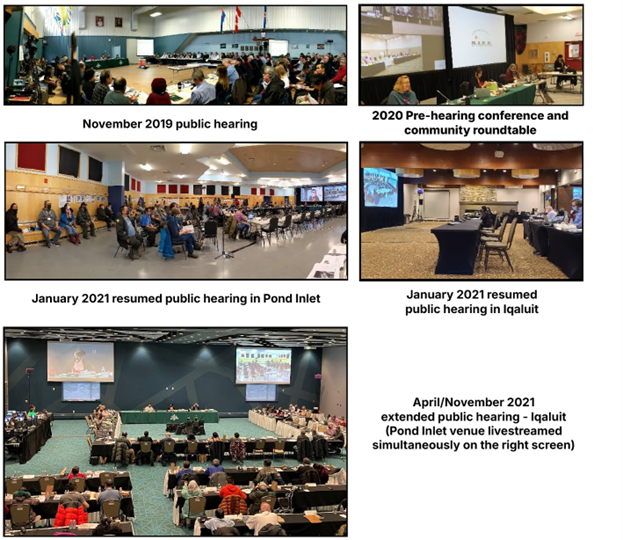
Photos courtesy of the Nunavut Impact Review Board
At the NIRB meetings, HTOs whose waters and lands were affected by the proposed phase 2 expansion routes, seaways, and environmental considerations, shared their views in the process. The NIRB heard concerns from HTOs on the Phase 2 proposal including the interference of the proposed railway on wildlife, expansion of the mine’s dust footprint, and the changing and increased marine transport traffic that could interfere with seal and narwhal hunting waters. Other considerations such as changing plans from Baffinland, share of community benefits from the project expansion, and inclusion of traditional knowledge were also heard from HTOs. Ultimately, the NIRB came to conclude in its review that the Phase 2 project should not proceed, and the Government of Canada ultimately rejected the proposal in 2022. However, Baffinland continues to pursue mine expansion (Pelletier, 2023) and HTOs such as the Igloolik Hunters and Trappers Association and the Sanirajak Hunters and Trappers Association must continue to advocate for their concerns with the project with their limited HTO resources (Bernauer, Kulchyski, & Sarpinak, 2025).
Public Engagement Capacities
To be able to fully participate in public engagements on projects, HTOs require more resources. As demonstrated by normal operational budgets, constraints on the cost-of-living for HTO staff and members, operational expenses, as well as the number of personnel available to each HTO, the capacity to provide feedback in consultation processes, engage in in-person meetings or meetings that require telecommunications services, or analyze proposals with legal and economic expertise is severely limited. According to the NIRB:
When designing a project and prior to submitting a project proposal to the Nunavut Planning Commission, it is recommended that the Proponent begin engagement and consultations as soon as possible with individual members of an affected community, as well as organized community interest groups. In each community there are a number of individuals, community groups or public interest groups who may have relevant community knowledge related to the proposed project and, as such, may be contribute to the Proponent’s knowledge in their respective area(s) of expertise. The NIRB recommends that public engagement occur throughout the life of the project, including, but not limited to:
- Project proposal development
- Impact assessment process (screening process and/or review process)
- Licensing/Permitting process
- Project development
- Closure
- Post-closure
It is important to present information in an acceptable manner with a focus on the recognition of the cross-cultural setting in Nunavut. Proponents are advised to recognize the history and economy of the community, as well as past community knowledge related to development and the NIRB process. Project proposals submitted to the NIRB for screening should contain a description of the public consultation program/strategy the Proponent has conducted, or intends to conduct. (Nunavut Impact Review Board, n.d.)
Though the entire review process by the NIRB may take years to complete, from initiation to final recommendations, there is also a limited window of time for HTOs to participate. HTOs must provide input at every phase of the review process, with the capacity to review and understand the information provided by the proponents and regulators during the input and public meeting stages. HTOs must also participate in the monitoring of projects, and are also consulted when projects closed.
Figure 3 – Three Phases of the NIRB Review Process
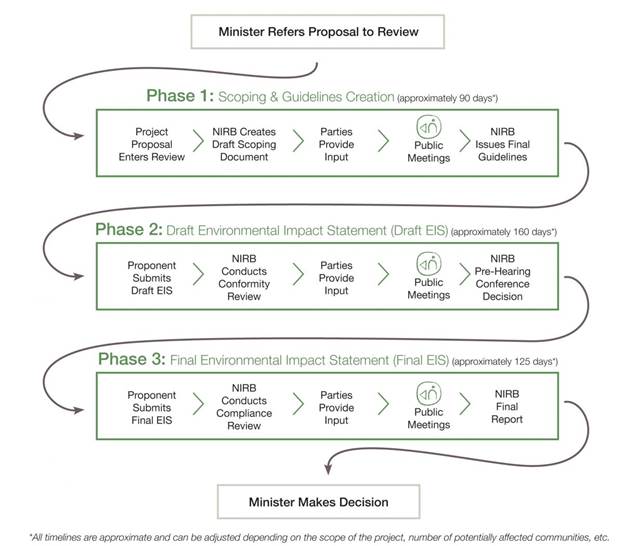
Diagram courtesy of the NIRB.
The information required to review for each project under the NIRB is an immense undertaking. For the Mary River Project alone, NIRB File No. 08MN053 reports have been filed since the NIRB began monitoring in 2012, with more documentation received for the file through the Phase 2 proposal review. In total, the NIRB lists 4233 documents related to the Mary River project, and 788 impact statements. The four-year review process of the Phase 2 proposal was the longest undertaking in the NIRB’s history, culminating in a 441 page final report that presented inputs, analysis, and policy recommendations on every aspect of the project’s expected social, economic, and environmental impacts. HTOs are expected to analyze these long, technical reports, and many would need to do so with a half-time office manager as the sole staff member.
Throughout the consultation process as well, HTOs must provide written correspondence and analysis through formal letters to the NIRB and other regulatory bodies to express their concerns. With little capacity draft analysis on environmental and economic impacts, while including traditional knowledge and knowledge of legal rights, HTO resources were stretched to keep pace with the process. On consultations regarding the Meliadine Gold Mine Project, located near Rankin Inlet:
HTOs appear to lack the capacity to meaningfully participate in group functions. Because the advisory group can continue without their involvement, HTOs have little leverage to compel either the proponent or government to provide them with the resources they require. This, combined with issues we have documented with stakeholder groups at the Mary River and Whale Tail projects, suggests that Inuit hunters may be unable to meaningfully participate in discussions about caribou mitigation for the Meliadine mine. (Bernauer W. H., 2023)
Without adequate resources provided by governments and project proponents to participate and engage in these consultation processes, HTOs may not have adequate capacity to share their community knowledge, insights, and concerns. The 2018-2022 NIRB process related to the Mary River Phase 2 proposal demonstrates the need for greater HTO capacities to fulfill consent obligations. When citizens feel as though the process does not allow for their concerns to be considered, they may resort to other measures around the process to make sure that they are heard.
In February 2021, a group of hunters from local communities in Pond Inlet and Arctic Bay blockaded the Mary River Mine’s air strip and road for two weeks in a peaceful demonstration against the Phase 2 expansion proposal. This occurred during the final weeks of the final phase of the consultation process. For Inuit and HTOs engaged at the Pond Inlet in-person engagement meeting:
The tension lies in whether there’s been enough research done to prove those statements. If the expansion goes ahead and the mine is wrong, Inuit in the surrounding communities fear losing the food sources they rely on. […] Communities say the research they’ve received from the mine leaves many questions unanswered, while the mine says it needs the expansion to happen now to keep its operation profitable. The mine’s current environmental monitoring program is half-staffed by Inuit. (CBC News, February 5, 2021)
Without the capacity to carry out their own research, expensive transport needs to participate in meetings in-person, or unreliable telecommunications infrastructure to facilitate virtual engagement, HTO resources meant for land and water stewardship and normal community operations are stretched just to participate in the nominally democratic process of consultation. Were an acceleration of projects in the national interest in the region to proceed given renewed considerations by the federal government and geopolitical situation, HTOs would certainly run up against challenges and limitations to their participation in engagement processes.
New Major Projects Initiative and the Continued Push for Phase 2 Expansion
In 2025, Prime Minister Mark Carney’s policy response in defence against the US economic war has called for a new strategy centered around “nation-building” infrastructure, such as ports, mines, trade corridors, and other pieces to increase natural resource extraction and supply chain speed. “To get nation-building projects built faster,” the government revamped the Major Projects Office, previously under Natural Resources Canada, to oversee an accelerated pace for reviews and approvals. Other Indigenous organizations such as the Union of British Columbia Indian Chiefs and the Chiefs of Ontario have expressed their alarming concerns regarding the expedition of nation-building projects, arguing that the proposed accelerate pace of project approvals does not meet legal obligations and undermines sovereignty. According to reporting from The Narwhal, the Mary River Phase 2 expansion proposal is being considered again as a part of the government’s ‘major projects’ list (Meyer, November 3, 2025).
After the rejection of its Phase 2 proposal, Baffinland immediately expressed its desire to continue with its plan to expand its transport infrastructure at Mary River. HTOs have again begun sending submissions to the NIRB outlining their concerns about the continued push for phase 2 expansion, calling for a full reassessment of the mine today, as previous reviews conducted more than a decade ago may be outdated with regards to wildlife and environmental data. The operation of the mine has also exceeded dust impact projections, requiring further monitoring (Venn, October 6, 2022). The Mary River expansion proponents can expect to receive support from the federal government in accelerating a new attempt for approval of this project. Local HTOs affected by the Mary River expansion, and other projects in Nunavut that receive ‘major project’ priority status, may be unable to engage in another review process in this accelerated environment without adequate resources.
Policy Options and Recommendations
As the federal considers reinforcement of sovereignty in the Arctic region, this policy transformation must remain rooted in Canada’s fiduciary obligation to Inuit. This report proposes an epistemic recentering of efforts to reinforce sovereignty, maintaining that social infrastructure for Indigenous northerners is a key pillar to promoting a secure and prosperous Arctic. For Inuit to engage fully with major projects assessment and review processes, HTOs and other Nunavut Institutions of Public Government must be able to express free, prior, and informed consent. While the system and processes in place for environmental and socioeconomic assessment appear robust, without resources, they cannot function. According to Inuk Elder Joan Scottie, with regards to another uranium mining project in Nunavut:
Without a doubt, this co-management framework looks pretty good on paper. There appear to be too many opportunities for community participation, and several checks and balances to protect the environment. However, my community’s experiences with gold and uranium mining show that our ability to influence these processes is actually very limited. Ultimately, this system leaves most real power in the hands of the mining companies. (J. Scottie, 2022)
To maximize benefits for Nunavummiut, the following two proposals are put forth.
Recommendation 1: Increased Funding for HTOs
The current funding model in place to support HTOs is clearly inadequate. The funding remains insufficient for the fulfillment of the organization’s service functions for the community. The Government of Canada should increase spending levels to HTOs to provide at least $1 million in operational budget annually to each organization across the territory and, on a case-by-case basis, allocate more resources depending on their size and membership.
Increased funding requires consideration of the high cost of living in Nunavut and cost of equipment and fuel, as well as consideration of the value of HTOs in their communities. Long-term investment into social infrastructure in Nunavut will create profound benefits for Nunavummiut, culturally and economically. Adoption of these measures would help to ensure that the organizations can fulfil their obligations under the NLCA, continue to support their respective communities, and contribute to the reaffirmation of sovereignty in the Arctic region.
This report leaned heavily on existing literature concerning the formulation of a living wage budget. The calculation utilized in this report was derived from that of Sandí, Saulnier, and Williams’ (2025) report on the living wage for the Atlantic provinces. Through this methodology considering the cost of basic living for a household, the 2025 living wage for Nunavut would be $31.25 per hour.
This calculation included considerations from six different categories, with a reference family developed to represent the average household size in the territory. These primary categories included food, clothing/outerwear, shelter, transportation, childcare, and household expenses. Data from a report on the MBM for Nunavut helped to further adjust this equation to account for the unique challenges facing Nunavummiut (Devin, Gusajtis, & McDermott, 2023).
Discussion and Conclusion
The Nunavut Agreement and the reinforcement of sovereignty in the Arctic cannot be realized without providing strengthened social infrastructure for Nunavummiut that aids in land management, economic activity, and cultural survival. By supporting HTOs in the territory, there are many projected benefits at the individual, household, organization, and societal levels—including regional security.
This report examines the longstanding infrastructure gap for Nunavummiut in Nunavut. To effectively bridge this gap, federal stakeholders must recognize and fulfill their duty to ensure that Indigenous northerners are well-resourced. On a high level, HTOs in Nunavut are severely underfunded, and increased funding would facilitate widespread benefits in Nunavut. Current funding models for these organizations do not account for the informal roles that HTOs play in their communities—including combating food insecurity, promoting cultural connectivity, and providing employment opportunities. To this end, it is no exaggeration to say that HTOs are an essential component of social infrastructure in Nunavut, and by extension, are key entities in reinforcing sovereignty in the Arctic.
As previously outlined, bridging the acute gaps in infrastructure for Nunavummiut through increased funding for HTOs would have wide-reaching benefits. First, HTOs would have adequate resources to complete their key roles outlined in the NLCA. At their core, these responsibilities include wildlife management and the oversight of harvesting practices. At a higher level, however, HTOs are stewards of the Arctic region. In this regard, Canada ought to act in the best interest of Nunavummiut. Canada must reassess its approach to promoting sovereignty if there is growing concern for regional security. Through decisive action, federal stakeholders can fulfil their fiduciary obligation to Nunavummiut and, as a corollary, contribute to the reaffirmation of sovereignty in the Arctic.
Works Cited
Alberni Power & Marine. (2024, February 23). A Comprehensive Guide to Boat Fuel Consumption. Retrieved from albernipowerandmarine.com: https://www.albernipowermarine.com/blog/a-comprehensive-guide-to-boat-fuel-consumption
Bell. (n.d.). Rate Plans. Retrieved from bell.ca: https://www.bell.ca/Mobility/Cell_phone_plans
Bernauer, W., Kulchyski, P., & Sarpinak, J. (2025, February 5). The battle for Steensby Inlet is not over. Canadian Dimension.
Cameron, A., Petiti, G., & Tedds, L. M. (2024, September 3). A Basic Income for Nunavut: Addressing Poverty in Canada’s North. Canadian Public Policy, 50(3), 311-328.
Canada Mortgage and Housing Corporation (CMHC). (2024, January 25). Northern Housing Report. Retrieved from cmhc-schl.gc.ca: https://www.cmhc-schl.gc.ca/professionals/housing-markets-data-and-research/market-reports/housing-market/northern-housing-report
Canadian Freelance Guild. (n.d.). What to Pay a Writer. Retrieved from canadianfreelanceguild.ca: https://canadianfreelanceguild.ca/en/page/page-content/what-to-pay-a-writer
Canadian Northern Economic Development Agency. (2025, December 5). Minister Chartrand announces $40.5 M to strengthen Northern Canada’s defence sector . Retrieved from canada.ca: https://www.canada.ca/en/northern-economic-development/news/2025/12/minister-chartrand-announces-405-m-to-strengthen-northern-canadas-defence-sector.html
Chan, H., Fediuk, K., Hamilton, S., Rostas, L., Caughey, A., Kuhnlein, H., . . . Loring, E. (2006). Food Security in Nunavut, Canada: Barrier and Recommendations. International Journal of Circumpolar Health, 65(5), 416-431.
Corporate Fleet Services. (2025, May). CFS Report – Fuel Price Update – Reimbursement for Business Use of Personal Vehicles . Retrieved from National Joint Council: https://www.njc-cnm.gc.ca/s3/d928/en
Department of National Defence. (2024). Our North, Strong and Free: A Renewed Vision for Canada’s Defence. Government of Canada.
Devin, N., Gusajtis, B., & McDermott, S. (2023). Construction of a Northern Market Basket Measure of Poverty for Nunavut. Income Research Paper, Statistics Canada.
D’Souza, S., Guerriero, L., & Angelovski, I. (2024, February 23). What’s behind rising food costs in Canada’s North? Questions emerge over how retailer sets prices. Retrieved from CBC: https://www.cbc.ca/news/canada/rising-food-prices-canada-north-1.7122481
EI Premium Rates and Maximums. (n.d.). Retrieved from Canada.ca: https://www.canada.ca/en/revenue-agency/services/tax/businesses/topics/payroll/payroll-deductions-contributions/employment-insurance-ei/ei-premium-rates-maximums.html
Employment and Social Development Canada. (2023, November 10). Governments of Canada and Nunavut Launch Early Learning and Child Care Action Plan. Retrieved from Canada.ca: https://www.canada.ca/en/employment-social-development/news/2023/11/governments-of-canada-and-nunavut-launch-early-learning-and-child-care-action-plan.html
Fawcett-Atkinson, M. (2024, May 27). Northern food is expensive. Is climate change to blame? Retrieved from Canada’s Nationsl Observer: https://www.nationalobserver.com/2024/05/27/news/Nutrition-North-subsidy-Nunavut#:~:text=Grocery%20prices%20are%20routinely%20two,t%20afford%20enough%20to%20eat.
Government of Canada. (n.d.). Canada.ca. Retrieved from Canada.ca: https://www.canada.ca/en/revenue-agency/services/tax/businesses/topics/payroll/payroll-deductions-contributions/canada-pension-plan-cpp/cpp-contribution-rates-maximums-exemptions.html
Government of Canada, Tungavik Federation of Nunavut. (1993). Nunavut Land Claim Agreement. Government of Canada.
Government of Nunavut. (2023, October 19). Qikiqtani: Licensed Child Care Centres . Retrieved from gov.nu.ca/education: https://www.gov.nu.ca/sites/default/files/documents/2023-12/Qikiqtani_10-27-23.pdf
Government of Nunavut. (2025). Minimum wage to rise to $19.75, formula introduced to adjust minimum wage annually . Iqaluit: gov.nu.ca.
Government of Nunavut. (2025, April 1). Petroleum Products Division Retail Price List. Retrieved from news.gov.nu.ca: http://www.news.gov.nu.ca/2025/september/2025-09%20(TIN)%20PPD%20prices_Sept%208%202025_display%20table%20-%20ENG.pdf
Government of Nunavut. (n.d.). Household Allowance. Retrieved from gov.nu.ca: https://www.gov.nu.ca/en/staff-resources/household-allowance
Li, N. (2025). Technical report on 2022-2023 food price increases in Qikiqtaaluk region, Nunavut. Toronto: ICFI Evaluation Team.
Loblaws. (n.d.). Olive Oils. Retrieved from loblaws.ca: https://www.loblaws.ca/en/food/pantry/oils-vinegar/olive-oils/c/29907
Lochead, D. (2022, November 18). Iqaluit HTO tells feds it needs more funding . Retrieved from Nunatsiaq News: https://nunatsiaq.com/stories/article/iqaluit-hto-tells-feds-it-needs-more-funding/#:~:text=’We%20have%20been%20left%20behind,which%20areas%20will%20be%20protected
Mercury Marine. (n.d.). Outboards. Retrieved from mercurymarine.com: https://mercurymarine.widen.net/s/nnjzvxmxpn/8m0215646_mercury_seapro-brochure_web
Nunavut Bureau of Statistics. (2012). StatsUpdate. Nunavut Bureau of Statistics.
Nunavut Impact Review Board. (2022). Highlights Document for the Board’s Reconisderation Report and Recommendations for Baffinland’s Phase 2 Development Proposal. Iqaluit: NIRB. Retrieved from https://www.nirb.ca/portal/dms/script/dms_download.php?fileid=339559&applicationid=124701&sessionid=li8jra28ratqomq94cba01c536
Nunavut Research Institute. (n.d.). nri.nu.ca. Retrieved from https://www.nri.nu.ca/trichinella-diagnostic-program
Nunavut Research Institute. (n.d.). nri.nu.ca. Retrieved from Trichinella Diagnostic Program: https://www.nri.nu.ca/trichinella-diagnostic-program
Nunavut Tunngavik Incorporated. (2004). Kangikhiteagumaven: A Plain Language Guide to the Nunavut Land Claims Agreement. Iqaluit: Nunavut Tunngavik Inc.
Parliament of Canada. (2025, November 5). House Publications. Retrieved from ourcommons.ca: https://www.ourcommons.ca/documentviewer/en/45-1/house/sitting-51/hansard
Pelletier, J. (2023, February 9). Baffinland plans to go back to Steensby. Nunatsiaq News.
Polar Knowledge Canada. (2024, September 9). Canada.ca. Retrieved from Trichinella in Arctic and Northern Canada: https://www.canada.ca/en/polar-knowledge/videos/trichinella.html
Premium Bookkeeping & Accountaing. (n.d.). How Much It Costs to Hire a Bookkeeper in Canada . Retrieved from premiumbookkeeping.ca: https://premiumbookkeeping.ca/how-much-it-costs-to-hire-a-bookkeeper-in-canada/#:~:text=Hourly%20rates%20for%20bookkeeping%20services,Monthly%20Packages
Repair Pal. (n.d.). Ford F-150 Repair & Maintenance Costs. Retrieved from Repair Pal: https://repairpal.com/ford/f-150
Royal Bank of Canada. (2024, May 8). Where Did My Money Go?: The Rising Cost of Groceries in Canada. Retrieved from rbcroyalbank.com: https://www.rbcroyalbank.com/en-ca/my-money-matters/debt-and-stress-relief/struggling-to-make-ends-meet/where-did-my-loonies-go-the-rising-cost-of-groceries-in-canada/
Sandí, D. C., Saulnier, C., & Williams, R. (2025). 2025 Living Wages for Newfoundland and Labrador, Nova Scotia and Prince Edward Island. Canadian Centre for Policy Alternatives.
Simon, M. (2009). Inuit and the Canadian Arctic: Sovereignty Begins at Home. Journal of Canadian Studies, 250-260.
Square. (n.d.). Square Register. Retrieved from squareup.com: https://squareup.com/ca/en/hardware/register?_gl=1*14hqofl*_up*MQ..*_gs*MQ..&gclid=CjwKCAiA0eTJBhBaEiwA-Pa-hWTI2GR-8mzp_tFVxST2mQa60JnQ4fmBPiDSSOTamwarLZamFbFu3BoCdlAQAvD_BwE&gclsrc=aw.ds&gbraid=0AAAAADuhHxp063zqvU2tMq83680VDCgDh
Starlink. (n.d.). Services Plans. Retrieved from starlink.com: https://starlink.com/ca/service-plans/business
Statistics Canada. (2021). Census Profile, 2021 Census of Population. Retrieved from statcan.gc.ca: https://www12.statcan.gc.ca/census-recensement/2021/dp-pd/prof/details/page.cfm?Lang=E&SearchText=Nunavut&DGUIDlist=2021A000262&GENDERlist=1,2,3&STATISTIClist=1&HEADERlist=0
Statistics Canada. (2021). Census Profile, 2021 Census of Population. Retrieved from stacan.gc.ca: https://www12.statcan.gc.ca/census-recensement/2021/dp-pd/prof/details/page.cfm?Lang=E&SearchText=nunavut&GENDERlist=1&STATISTIClist=1&DGUIDlist=2021A000262
Tom Wood Ford. (n.d.). 2025 Ford F-150 MPG & Gas Mileage: How Fuel Efficient Is The F-150? . Retrieved from tomewoodford.com: https://www.tomwoodford.com/ford-f-150-mpg.htm#:~:text=The%202025%20Ford%20F%2D150%20has%20great%20gas%20mileage%20for,Ford%20F%2D150%20EcoBoost%20engines: